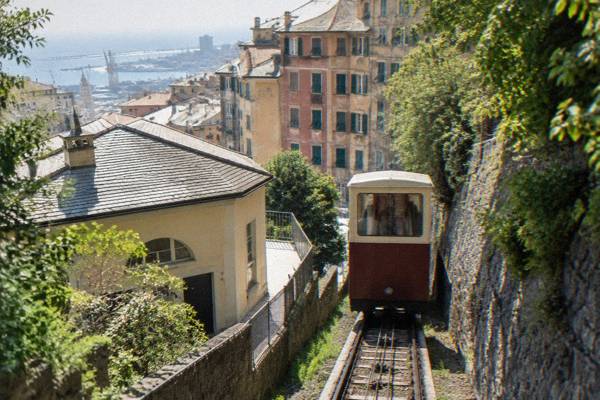
Spianata Castelletto: The Art Nouveau Lift To Genoa's Balcony
Spianata Castelletto is Genoa's rooftop terrace above the old town, reached by a public lift that climbs 57 metres from Piazza Portello for the price of a bus ticket.
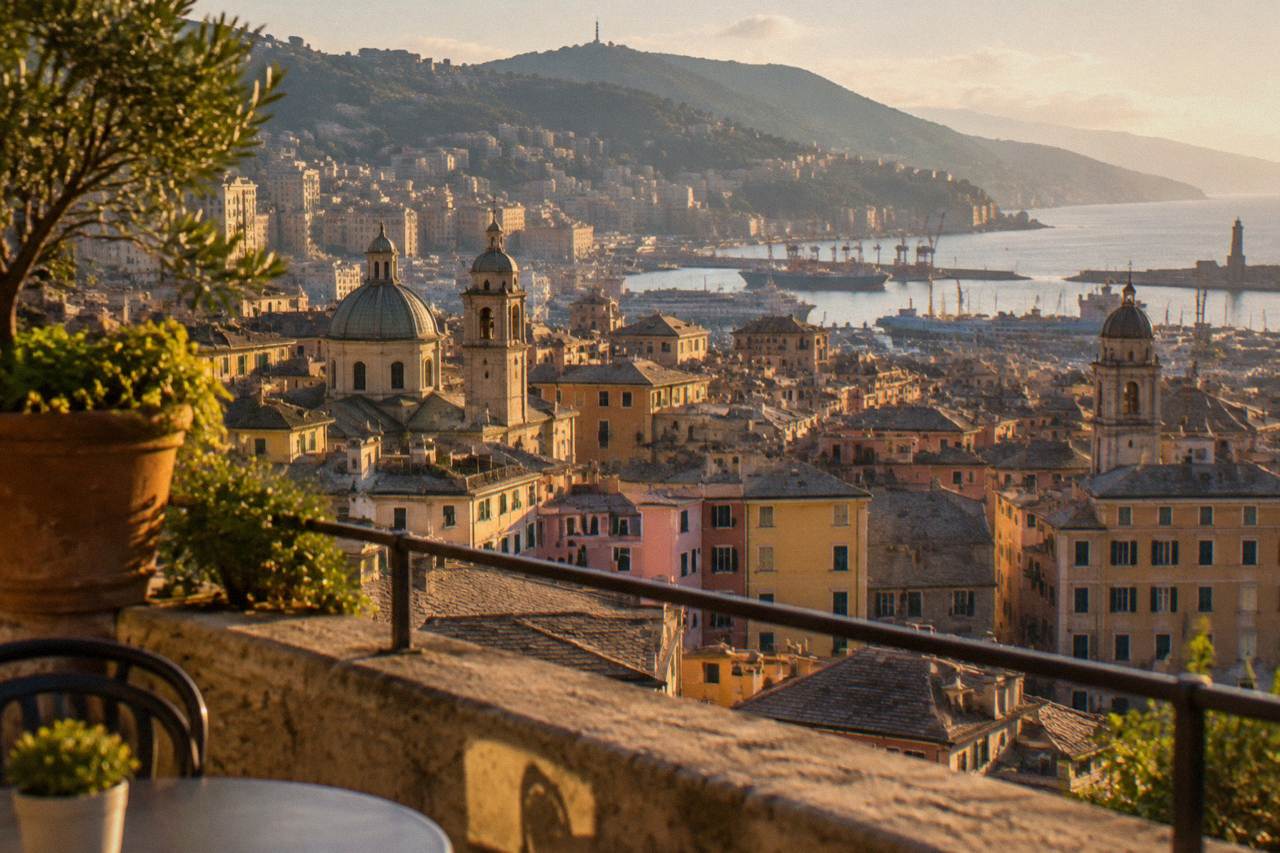
Short answer
The Castelletto Levante lift runs from Piazza Portello up to Spianata Castelletto every day from 06:40 to 24:00. A single ride costs 1.00 EUR with an ordinary AMT ticket or 1.20 EUR with a dedicated vertical-transport ticket.
Genoa climbs a hillside straight out of the Ligurian Sea, and Spianata Castelletto is the terrace where the city pauses for breath. The belvedere sits in the Castelletto district, about 0.7 km from Piazza De Ferrari in a straight line, yet the 57 metres of height between the street grid and the terrace are exactly what makes it feel like another city entirely: the red roofs of the historic centre, the Lanterna to the west and the curve of the coast read best from this one raised platform. AMT, the city transport operator, runs a public lift, the Castelletto Levante, from Piazza Portello directly to the Spianata, alongside a wider family of 14 lifts and two funiculars that Genoa uses to move between its vertical layers. This guide sets out what the terrace offers, what the lift costs, how the tickets work, and what to combine with a visit.
What Is Spianata Castelletto In Genoa?
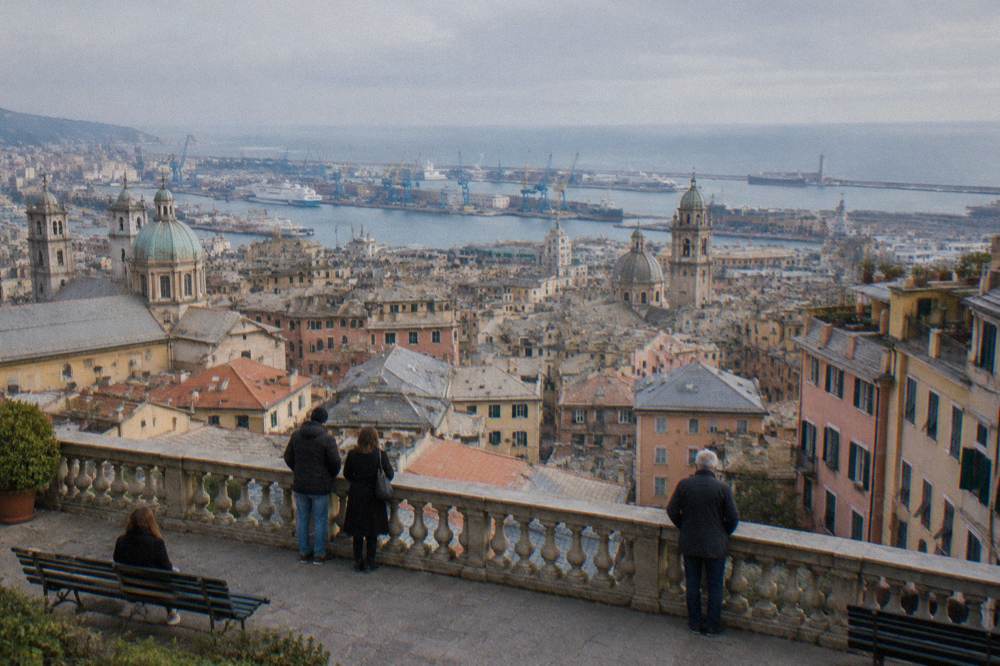
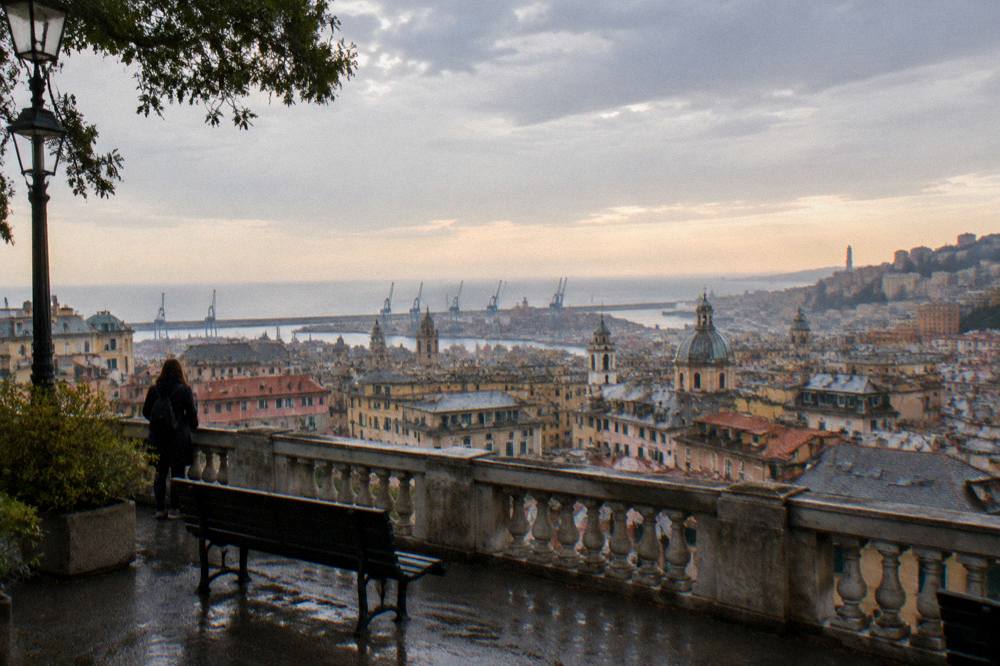
Spianata Castelletto is a panoramic terrace in the Castelletto district of Genoa, Liguria's coastal capital on the Ligurian Sea, positioned about 0.7 km in a straight line from Piazza De Ferrari but roughly 57 metres above the street level of Piazza Portello, from which the Castelletto Levante public lift carries passengers up to it every day of the week. The terrace functions as the city's principal free viewpoint over the centre. From the platform the eye travels across the dense roofscape of one of the largest medieval historic centres in Europe, down to the Porto Antico and the working port beyond it, and out along the coast toward the hills that frame the city on every side.
The name describes the geography honestly. A "spianata" is a levelled space, and Castelletto is the residential district that occupies the hill immediately north of the centre. The terrace exists because the hillside was cut back and terraced as the district developed, leaving a flat edge with an unobstructed drop toward the sea. The result is one of the few places in Genoa where the whole vertical logic of the city, sea, port, centre, hillside, can be read in a single glance.
What makes the terrace practical rather than merely scenic is the lift. Genoa's public transport operator AMT runs 14 public lifts across the city, treating them as ordinary transit infrastructure rather than tourist attractions, and the Castelletto Levante lift is the one that serves this terrace. It runs daily from 06:40 to 24:00, the same service window as the Zecca-Righi funicular, which climbs a different flank of the same hill.
For planning purposes the terrace pairs naturally with the rest of the centre. It sits within walking distance of Piazza De Ferrari once the lift has done the climbing, and it fits easily into a route between the Porto Antico and the museums of the old town. The full menu of options is on the site's things to do in Genoa page, where the terrace anchors the viewpoints section.
How Much Does The Castelletto Levante Lift Cost?
A single ride on the Castelletto Levante lift costs 1.20 EUR with the dedicated vertical-transport ticket, but the ordinary AMT ticket, at 2.00 EUR and valid 110 minutes on the whole metropolitan network, also covers the lift, so a visitor holding any standard AMT ticket rides without buying anything extra, and lift rides are included in the daily and carnet products. The lift is priced as transit, not as an attraction, which is the key planning fact: nobody needs a separate viewpoint ticket.
The fare structure comes from AMT's own ticket pages. The vertical ticket, which covers one ride on the public lifts and on the Sant'Anna funicular, is the cheapest single-purpose option at 1.20 EUR. The ordinary ticket at 2.00 EUR buys 110 minutes of travel on the entire AMT network, buses, metro and lifts alike, which makes it the better buy for anyone combining the terrace with a bus ride in the same journey. A carnet of eleven ordinary tickets costs 20.00 EUR.
| Ticket | Price | What it covers |
|---|---|---|
| Vertical ticket | 1.20 EUR | One ride on public lifts and the Sant'Anna funicular |
| Ordinary AMT ticket | 2.00 EUR | 110 minutes on the whole AMT network, lifts included |
| AMT + Trenitalia integrated | 2.20 EUR | 110 minutes including limited Trenitalia sections |
| 5-hour ticket | 5.00 EUR | Five hours on the AMT network |
| Carnet, 11 ordinary tickets | 20.00 EUR | Eleven 110-minute tickets |
| Met Daily | 10.00 EUR | 24 hours on the full network, Volabus included |
Two purchase details matter. Tickets are sold through the AMT app, by SMS, through contactless payment on board, at machines and at retailers across the city, so the lift is not dependent on a staffed booth. And the same ticket rules apply to the whole vertical network: the 14 lifts, the Sant'Anna funicular at 1.20 EUR a ride, and the Zecca-Righi funicular, which accepts ordinary urban tickets as well.
Set against the other paid viewpoints in the city, the arithmetic stays favourable. The Bigo panoramic lift at the Porto Antico is listed by the Aquarium's site at 6.00 EUR for an adult, and the combined Aquarium, Biosfera and Bigo ticket starts from 37.00 EUR. Those give a harbour-level panorama over the water. The Spianata gives the city-side panorama, at the price of a bus ticket.
How Do You Get To Spianata Castelletto?
The direct route is the Castelletto Levante lift from Piazza Portello, running daily 06:40 to 24:00 and climbing the full 57 metres to the terrace in one ride; the lift is part of the AMT network, so the ordinary 2.00 EUR ticket, any valid AMT product or the 1.20 EUR vertical ticket all work, and the terrace is about 0.7 km from Piazza De Ferrari in a straight line. The walk from the centre to the lift entrance is short and flat by Genoa standards; it is the climb after Piazza Portello that the lift removes.
The alternatives come from the same hill's other transport. The Zecca-Righi funicular, about 1.9 km from Piazza De Ferrari in a straight line at its lower station, runs daily 06:40 to 24:00 and serves the upper reaches of the hill through seven stations on a ride of about 12 minutes. From its upper levels the terrace can be reached along the ridge. The funicular accepts the same ordinary tickets as the lift, or the vertical fare.
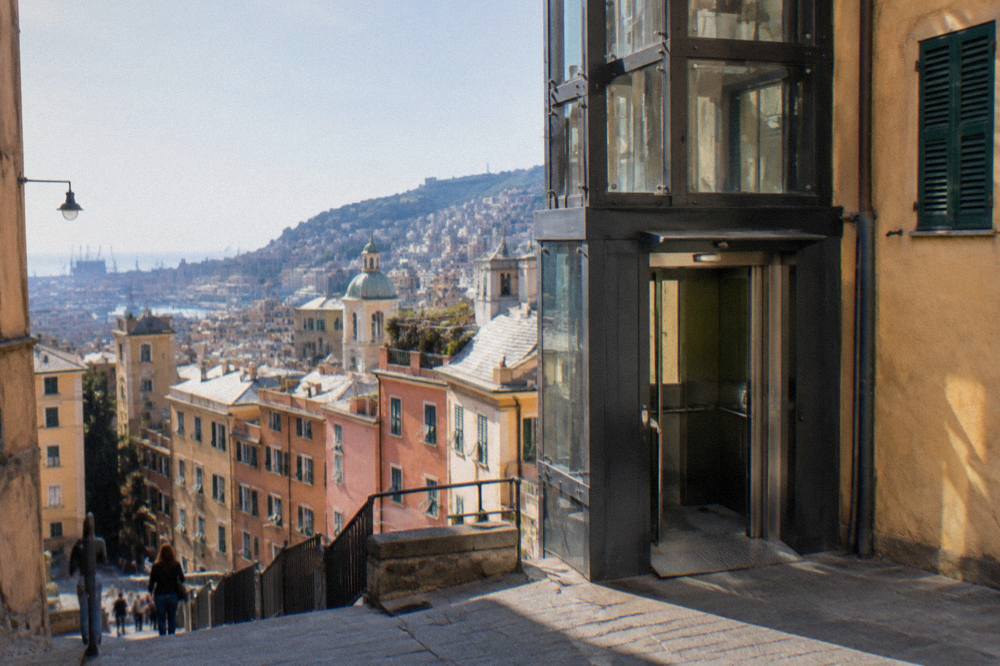
The third option is to walk, which is what the district's own residents do on the stepped lanes that stitch Castelletto to the centre below. Genoa's metro reaches neither the terrace nor the funicular's summit; the line runs 7 km with eight stations from Brin to Brignole, passing through Principe, Sarzano/Sant'Agostino and De Ferrari but staying in the valley. The lift and the buses are the transit answer to the hill.
A combined loop works well as a half-day plan: up by lift from Piazza Portello, time on the terrace, then along the ridge to the upper funicular station and down by the Zecca-Righi to the Via Garibaldi and Musei di Strada Nuova, whose three palaces hold the combined ticket with Sant'Agostino at 14.00 EUR full and 9.00 EUR reduced. The walk delivers the same vertical story the lift tells in ninety seconds.
For visitors who prefer the hill's story told aloud, a guided option exists: the site's featured audio and written commentary walk, Genova Walking Tour with Audio and Written Guide by a Local, routes through the centre and its raised terraces with the commentary carried on the walker's own device, and the operator's live listing carries the current price and availability: Check availability
Between the terrace and the funicular, the hill also lends itself to a guided panoramic itinerary, and one such option appears below for readers comparing the formats.
To hear the hill's stories while you walk it, book a panoramic storytelling tour here.
What Can You See From Spianata Castelletto?
The terrace looks south across the full width of central Genoa: the roofscape of the old town, one of the largest medieval historic centres in Europe at 113 hectares, fills the foreground, the Lanterna lighthouse stands westward at the port, 117 metres above the sea on its rock, and the line of the coast runs east toward the hills above Nervi, with the Cathedral of San Lorenzo's towers and the M-shaped profile of the port cranes between them. It is the one viewpoint where the city's three layers, medieval centre, industrial port and hillside districts, sit in a single frame.
Reading the view is easier with a few anchors. The Cathedral of San Lorenzo sits near the centre of the old-town mass, its striped front marking the heart of the caruggi district. To its west the grid of the Strade Nuove, Via Garibaldi and the Palazzi dei Rolli, breaks the medieval tangle with straight Renaissance streets; the UNESCO inscription "Genoa: Le Strade Nuove and the system of the Palazzi dei Rolli" covers 42 palaces there, inscribed in 2006. Beyond them, the Lanterna marks the outer port.
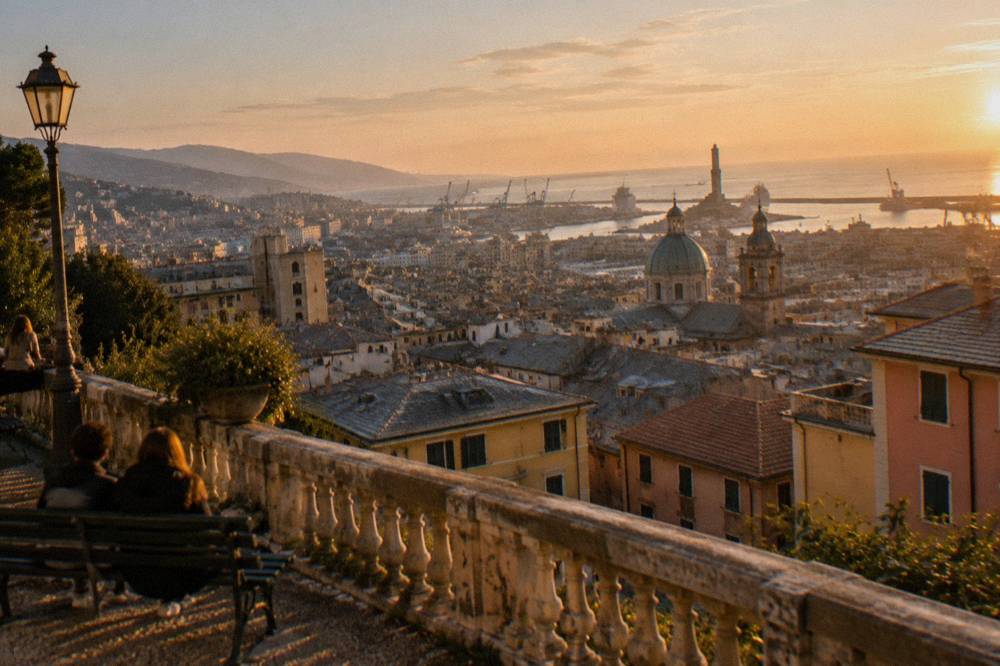
Eastward the eye follows the coast. Nervi lies about 9 km away in a straight line, its cliff-top promenade hidden by the headlands, and the hills of the Portofino promontory close the horizon on clear days at about 25 km. Below the terrace to the south, Piazza De Ferrari sits roughly 0.7 km away in a straight line, close enough that the square's outline and the opera house beside it are readable from the railing.
| Sight visible from the terrace | Straight-line distance | Direction |
|---|---|---|
| Piazza De Ferrari | about 0.7 km | South, below |
| Corso Italia seafront | about 4 km | South-east |
| Nervi and its parks | about 9 km | East along the coast |
| Camogli | about 18 km | East, beyond the headland |
| Portofino promontory | about 25 km | South-east horizon |
The terrace also reads Genoa's vertical transport from above. The lift shaft that carried you up is visible on the hillside, the Zecca-Righi funicular's track cuts the opposite flank, and the whole assembly of stairs and terraces explains why this city of 566,247 residents in the comune, per ISTAT figures at 1 January 2026, built lifts where other cities built tram lines.
When Is The Castelletto Levante Lift Open?
The Castelletto Levante lift runs every day from 06:40 to 24:00, according to AMT's lifts page, the same daily service window as the Zecca-Righi funicular and the Castelletto lift's weekend extensions, which makes the Spianata reachable from early morning to late evening without any seasonal closure to plan around. The hours are transit hours, set for residents as much as for visitors, so the lift does not keep attraction-style opening times.
The terrace itself is a public open space with no gate, ticket or closing time of its own; the lift's service window is the operative constraint. Arriving outside it means the walk up the district's stepped lanes, which the hillside provides in place of a road switchback. The wider set of guides lives on Genoa Travel Guide.
Weather is the honest variable for a viewpoint. Genoa's climate, per the official 1971-2000 normals for Genoa Sestri, is Mediterranean coastal: January averages a high of 11.5 C and a low of 5.5 C, August a high of 27.7 C and a low of 21.0 C. Rain is distributed unevenly through the year, and October, at 171.3 mm, carries more rain than any other month in the normals table.
| Month | Mean high C | Mean low C | Rain mm |
|---|---|---|---|
| Jan | 11.5 | 5.5 | 101.8 |
| Feb | 12.2 | 6.0 | 74.0 |
| Mar | 14.6 | 8.2 | 81.7 |
| Apr | 16.8 | 10.5 | 88.0 |
| May | 20.5 | 14.2 | 72.4 |
| Jun | 23.9 | 17.6 | 58.2 |
| Jul | 27.3 | 20.9 | 24.2 |
| Aug | 27.7 | 21.0 | 69.3 |
| Sep | 24.4 | 17.9 | 136.4 |
| Oct | 20.0 | 13.8 | 171.3 |
| Nov | 15.1 | 9.2 | 108.8 |
| Dec | 12.5 | 6.5 | 93.1 |
One weather-linked rule worth knowing applies to the city's hills: the Strada Nuova museums close on red weather alerts, so on the worst rain days the hillside plan should shift to the covered sights, the Palazzo Ducale, whose World Press Photo 2026 exhibition runs to 8 December 2026, or the Galata Museo del Mare, open 10:00 to 19:00.
Spianata Castelletto Or The Zecca-Righi Funicular?
The lift and the funicular serve different halves of the same hill: the Castelletto Levante lift climbs 57 metres from Piazza Portello straight to the Spianata, while the Zecca-Righi funicular, about 1.9 km from Piazza De Ferrari at its lower station, climbs through seven stations on a roughly 12-minute ride to the Righi summit, so the choice is really between the terrace itself and the higher, longer ascent. Both run daily 06:40 to 24:00 and both accept the same tickets.
The funicular's route makes it a journey in its own right. Its seven stations step up the western flank of the hill, and from its upper terminus the ridge paths continue toward the terraces and fortifications above the city, the country of the Parco delle Mura and its forts. The lift, by contrast, is a single vertical move that deposits its passengers precisely at the viewpoint.
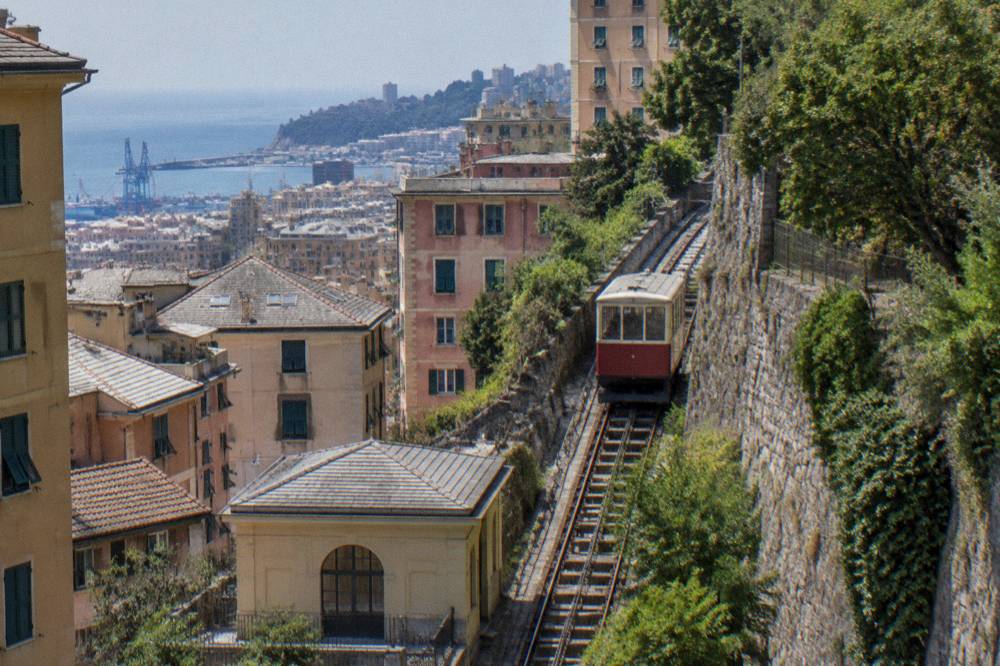
The sensible answer for a full day is both, in a loop. Up by lift, along the terrace, over the crest to the funicular's upper stations, down by funicular to the Strada Nuova. In ticket terms the loop costs nothing beyond ordinary AMT fares, since both modes sit inside the same 2.00 EUR, 110-minute ticket or the Met Daily at 10.00 EUR for 24 hours.
There is a third vertical option on this hill's edges that visitors often confuse with these two: the Montegalletto lift, which serves Castello d'Albertis from Balbi on weekdays from about 07:10 and on holidays from about 07:15, at the same 1.20 EUR single fare. It is a different destination, a castle museum rather than an open terrace, and it runs shorter hours than the two Castelletto workhorses.
What Is Near Spianata Castelletto?
Within a short radius of the terrace the highlights are the Musei di Strada Nuova on Via Garibaldi, downhill from the Spianata, the Castello d'Albertis museum on the hill's western shoulder, Piazza De Ferrari and the Palazzo Ducale in the centre below, and the Villa del Principe further east toward the port side, all reachable on foot once the lift has carried the climb. The terrace is not an excursion in itself; it is the high point of a centre walk.
The natural descent runs through the Strada Nuova. The three palaces, Palazzo Rosso, Palazzo Bianco and Palazzo Doria-Tursi, operate a combined ticket with the Museo di Sant'Agostino at 14.00 EUR full and 9.00 EUR reduced, and in the winter timetable from 28 September 2026 to 18 April 2027 they open daily 10:00 to 18:30, with Monday visits limited to Palazzo Rosso. Palazzo Doria-Tursi holds the violin "Il Cannone", built in Cremona in 1743 by Bartolomeo Giuseppe Guarneri and associated with Paganini.
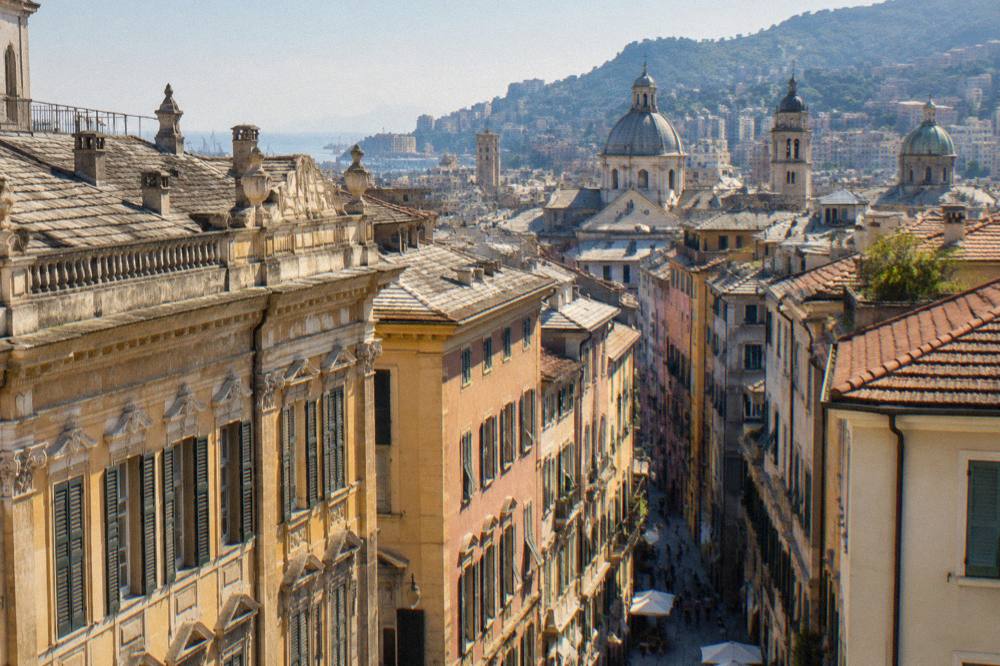
Closer to the lift's base, the Cathedral of San Lorenzo anchors the old town, and its treasury museum keeps hours of 09:00 to 12:00 and 15:00 to 18:00 Monday to Saturday, closed Sunday. The caruggi around it hold the Casa di Colombo, where Columbus lived between 1455 and 1470, a stop covered in detail on the site's Christopher Columbus in Genoa page.
For visitors with a full day and a taste for the coast, the terrace pairs with an afternoon descent to the sea: Camogli lies about 18 km away in a straight line, and the boat and train options for that run are laid out on the Camogli day trip page. A morning above the roofs, an afternoon on the water is the shape of a good Genoa day.
| Nearby sight | Relation to the terrace | Ticket figure |
|---|---|---|
| Musei di Strada Nuova | Downhill, off the Strada Nuova grid | 14.00 EUR combined full, 9.00 reduced |
| Piazza De Ferrari | About 0.7 km in a straight line, below | Public square |
| Cathedral of San Lorenzo | In the old town below the terrace | Cathedral entry by donation |
| Castello d'Albertis | On the hill's western shoulder | Museum card or venue ticket |
| Porto Antico and Aquarium | Downhill toward the water | Aquarium adult from 26.00 EUR |
| Camogli (day trip) | About 18 km in a straight line | Train or boat, see day-trip page |
Where Do You Eat Around Spianata Castelletto?
The honest eating plan for the terrace is to bring nothing and eat downhill: the old town between the lift's base and the centre carries Genoa's staples, pesto genovese made with Basilico Genovese PDO basil, focaccia and farinata, and the site's food pages cover each one, with a fuller primer in the farinata guide, while the terrace itself is an open public space rather than a dining venue. No restaurant names are needed to eat well below it.
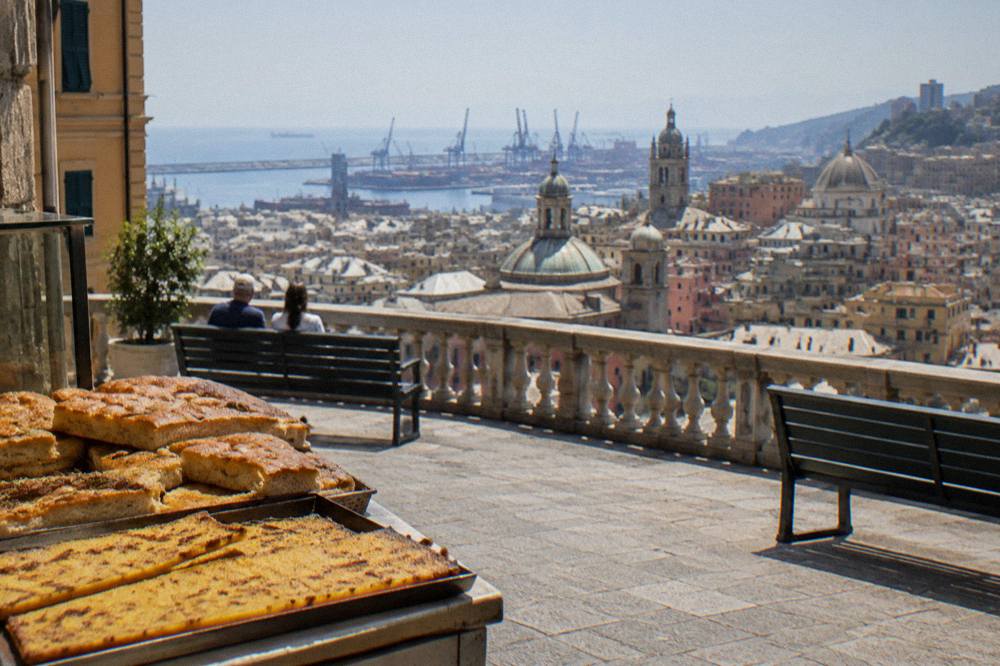
The district's own food identity is real. Pesto genovese, the basil, pine kernel and cheese sauce pounded for the city's trofie pasta, depends by specification on Basilico Genovese PDO, the protected basil grown in the Ligurian coastal strip. Focaccia, the oiled and salted flatbread, is the city's everyday bread, and farinata, the chickpea pancake baked in a wood oven, is the old port worker's lunch that survives in the caruggi bakeries.
Visitors who want the food explained rather than merely sampled have two good options in the roster. A guided tasting walk through the centre pairs the old town's lanes with wine and local dishes, and a cooking class turns the same raw materials into a meal learned rather than eaten. Both run in the city core, a lift ride away from the terrace.
The terrace's own contribution to eating in Genoa is simpler: it is the place where the walk pauses. The custom that pairs with the Spianata is the late-morning or early-evening passeggiata logic of Italian hillside cities, the slow loop with a stop at the railing, before descending into the caruggi for lunch.
Is Spianata Castelletto Good Value Compared With Genoa's Other Viewpoints?
Counted in euros the Spianata is the cheapest raised view in Genoa: 1.20 EUR for a vertical single or nothing extra beyond an ordinary 2.00 EUR AMT ticket already held, against the Bigo panoramic lift listed by the Aquarium's site at 6.00 EUR for an adult and the combined Aquarium, Biosfera and Bigo ticket from 37.00 EUR, while the Zecca-Righi funicular costs the same ordinary fares as the lift for a longer climb. The comparison is not only about price, since each looks a different way.
The Bigo, the crane-arm lift at the Porto Antico, looks seaward over the harbour from a low platform; the Aquarium's own pages give its standalone fare as 6.00 EUR adult, 5.00 EUR reduced, and fold it into the combined tickets. The Spianata looks landward and downward over the whole centre. The funicular looks at the hill itself during the ride and serves the upper ridge. A visitor with time does all three for under 10 EUR in fares.
| Viewpoint | Mode | Price | Service window |
|---|---|---|---|
| Spianata Castelletto | Castelletto Levante lift | 1.20 EUR single, or any AMT ticket | Daily 06:40 to 24:00 |
| Righi summit | Zecca-Righi funicular | Ordinary AMT fares | Daily 06:40 to 24:00 |
| Bigo, Porto Antico | Panoramic lift | 6.00 EUR adult, 5.00 reduced, as listed | With the Porto Antico attractions |
| Sant'Anna funicular | Funicular | 1.20 EUR single | Daily about 07:00 to 00:30 |
The terrace also holds its value against the paid museums on the hill below it. The Genoa Museum Card, at 24 EUR for 24 hours and 45 EUR for 48 hours under the 2026 rates, covers 28 city museums, and its "+bus" variants add AMT transport, but an ordinary AMT ticket already reaches the Spianata, so the card decision and the viewpoint decision are separate.
A practical footnote on the descent: the lift runs to 24:00, but the last ordinary planning detail worth fixing in advance is the ticket itself. The AMT app, contactless on board and the machines at the metro stations all sell the ordinary ticket, and the vertical ticket is sold through the same channels.
For travellers who want the hill's story told as they walk it, the audio-commentary format below is the same featured tour introduced earlier, shown here in its card form for side-by-side comparison with the hop-on hop-off option above.
Whichever format wins, the terrace itself costs less than any of them, and the closing trio below gathers the full comparison set for a final look.
Common Questions About Spianata Castelletto
Is Spianata Castelletto free to visit?
The terrace is a public open space with no entry charge. The Castelletto Levante lift that serves it costs 1.20 EUR for a single vertical ride, or nothing extra with a valid ordinary AMT ticket at 2.00 EUR for 110 minutes.
How do I get to Spianata Castelletto?
Take the Castelletto Levante lift from Piazza Portello, which runs daily from 06:40 to 24:00 and climbs 57 metres to the terrace. The lift is part of the AMT network, so ordinary tickets, carnets and the Met Daily are all valid.
What are the Castelletto lift opening hours?
The Castelletto Levante lift runs every day from 06:40 to 24:00, matching the Zecca-Righi funicular's daily service window on the same hill.
Can I walk to Spianata Castelletto instead of taking the lift?
Yes. The Castelletto district connects to the centre through stepped lanes, and the terrace lies about 0.7 km from Piazza De Ferrari in a straight line. The 57 metres of height difference are the reason the lift exists.
Is Spianata Castelletto the best viewpoint in Genoa?
It is the principal free one over the historic centre. The Bigo lift at the Porto Antico gives the seaward view at 6.00 EUR adult as listed, and the Zecca-Righi funicular serves the higher Righi area, so each viewpoint looks a different direction.
Does the Genoa Museum Card include the lift?
The 2026 Museum Card at 24 EUR for 24 hours and 45 EUR for 48 hours covers 28 city museums; only the "+bus" variants add AMT transport, and a plain ordinary AMT ticket at 2.00 EUR already covers the lift for 110 minutes.