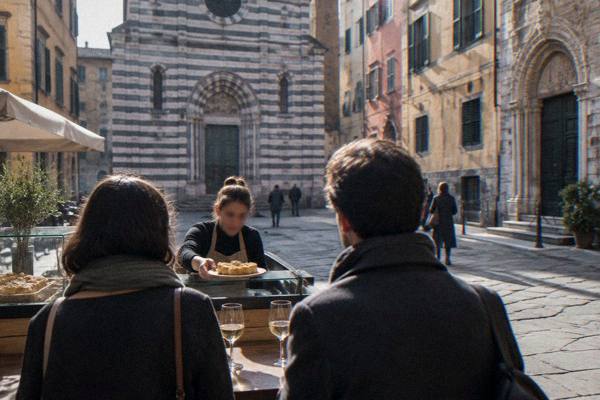
Farinata: Genoa's Chickpea Flatbread From The Wood Oven
Farinata is the chickpea flatbread baked in wood ovens across Genoa, a coastal city in Liguria on the Ligurian Sea, and this page sets it in its food context: the dishes it sits beside, the tours that walk you through them, and the prices around the table.
Short answer
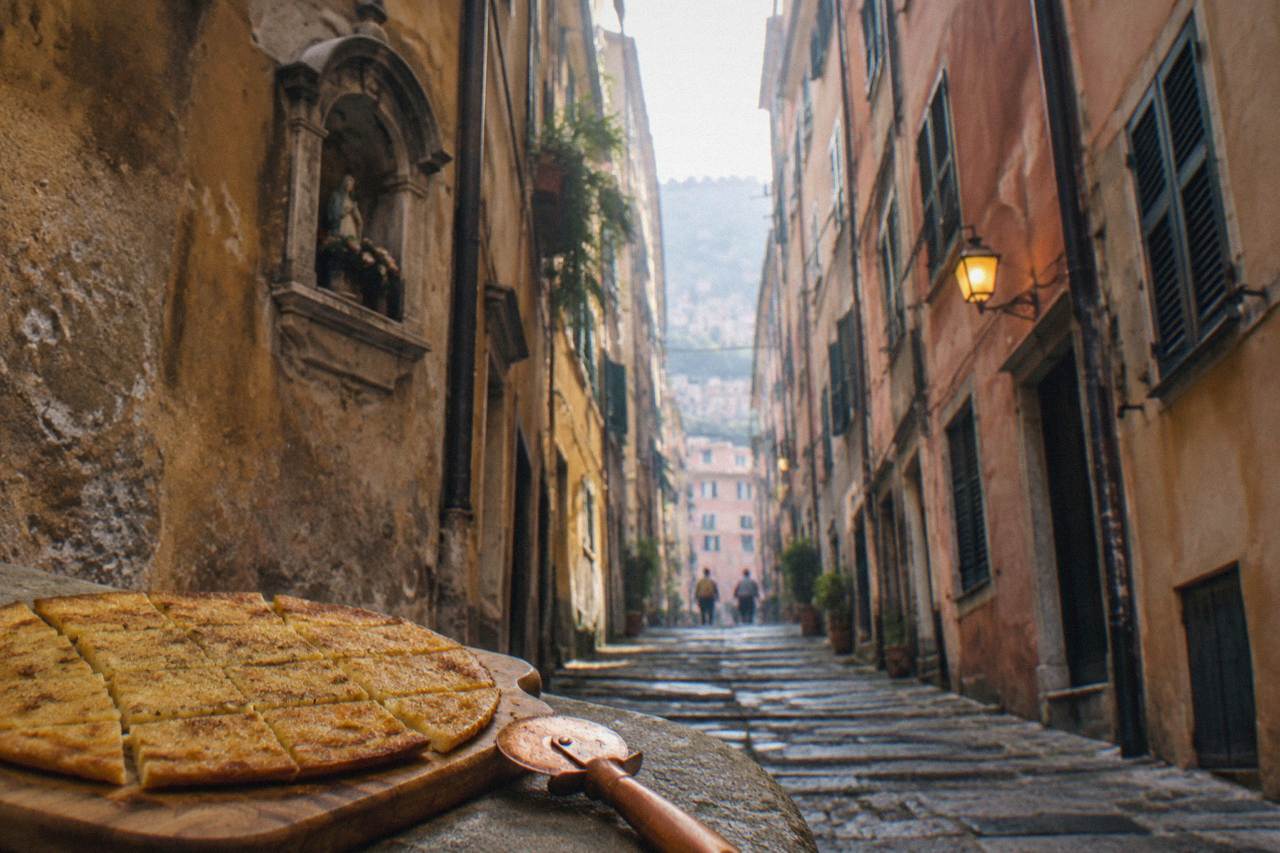
**Farinata is a thin, unleavened flatbread of chickpea flour, water, olive oil and salt, baked fast in a very hot wood-fired oven until the edges crisp and the middle stays soft. In Genoa it is street food and side dish at once, sold by the slice and eaten warm, and it belongs on any eating itinerary beside pesto genovese, focaccia and trofie.**
Farinata begins with four things: chickpea flour, water, olive oil and salt. The batter rests, then meets a copper pan in a wood-fired oven hot enough to set the middle and blister the edge in minutes. In Genoa, the coastal capital of Liguria on the Ligurian Sea, the result is both street food and table bread, cut into rough squares and eaten while it still carries the heat of the pan. This page from the Genoa Travel Guide sets the dish in its context: the other plates of the Genoese kitchen, the guided walks and cooking classes that build a day around them, and the prices that shape a food-focused trip. For the wider eating picture, start with what to eat in Genoa and the main things to do in Genoa.

What Is Farinata Genovese?
Farinata genovese is a thin round flatbread made from chickpea flour, water, olive oil and salt, poured as a loose batter and baked in a fiercely hot wood oven so that it sets into a golden sheet with a soft interior and crisped edges. It carries no yeast and no leavening of any kind, and in Genoa it is cut into squares, sold by weight or by the slice, and eaten warm as street food or as a side dish. The dish sits in a Ligurian family of simple pulse and bread preparations, and the site's food pages cover the four companion plates the Genoese kitchen is known for: farinata itself, pesto genovese, focaccia and the pasta shapes trofie and pansoti. What the sources do support about the dish's neighbours is precise. Pesto genovese is made with Basilico Genovese PDO basil, a protected cultivation tied to the Ligurian terroir, and focaccia di Recco carries IGP status, granted in 2015, with production limited to four communes: Recco, Camogli, Sori and Avegno. That regulatory frame tells you how seriously this coast treats its flatbreads.
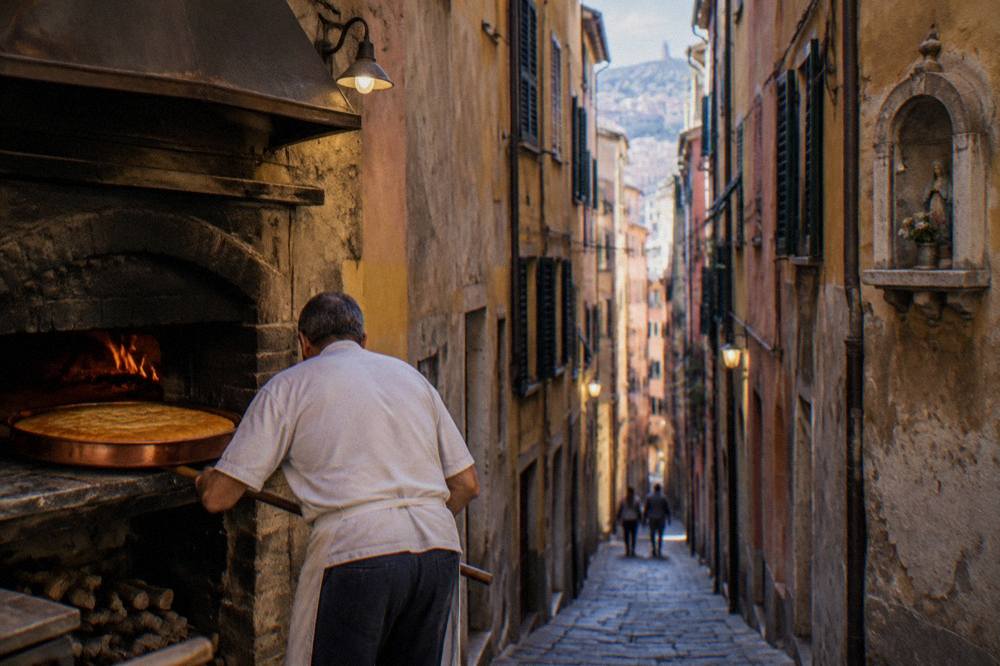
The practical consequence for a visitor is that farinata is a snack with a schedule. It comes out of the oven in batches, it is at its best minutes later, and a bakery's output is tied to the rhythm of its oven rather than to a display case. The dish is also one of the cheapest entries into Genoese eating, and it needs no reservation, no menu and no table: it is bought at a counter and often eaten standing. Pair it with a look at the old town's caruggi and food stalls, or fold it into a longer day built around pesto genovese, the sauce that shares the same Ligurian emphasis on few ingredients done exactly right.
How Does Farinata Compare With The Other Breads Of Liguria?
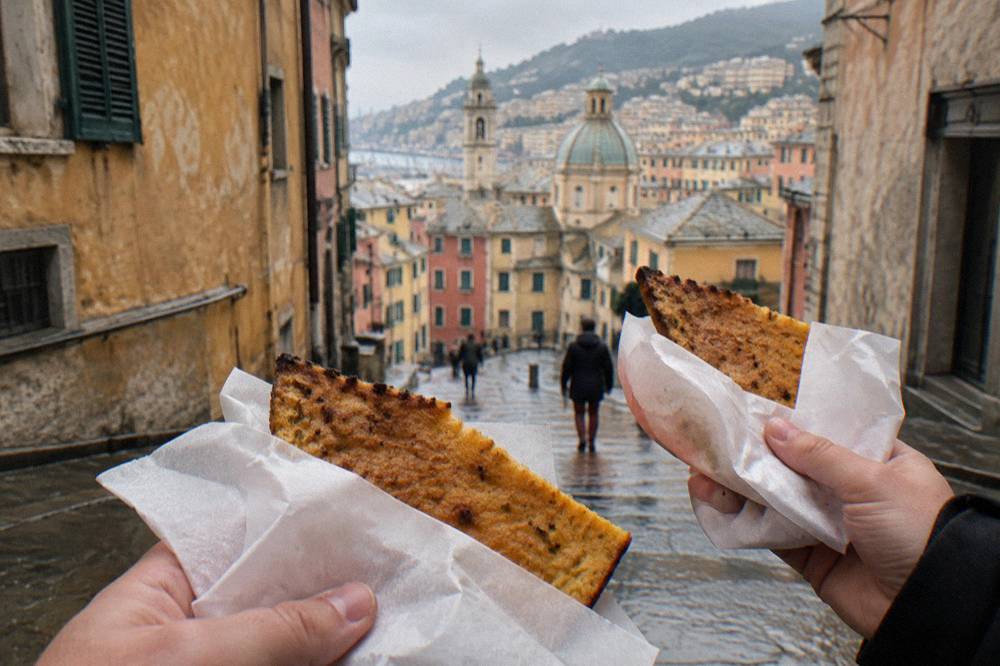
Farinata differs from focaccia in base and method: farinata is an unleavened chickpea batter baked in minutes in a wood oven, while focaccia is a leavened wheat dough, and focaccia di Recco is a distinct IGP product of two thin dough layers with a soft cheese filling, made only in Recco, Camogli, Sori and Avegno since the IGP was granted in 2015. Basil, the soul of pesto genovese, is protected separately as Basilico Genovese PDO. These protections matter because they make the Genoese table unusually traceable: the basil has a defined growing area, the Recco flatbread has a defined production zone and a date, 2015, and the chickpea flatbread you buy in the old town belongs to a local tradition rather than a national one. The table below sets the four foods side by side with what the sources actually state about each.
| Food | Base | Leavened | What the sources state |
|---|---|---|---|
| Farinata | Chickpea flour, water, olive oil, salt | No | A Genoese street food sold by the slice, baked in a wood oven |
| Focaccia genovese | Wheat dough, olive oil, salt | Yes | One of the signature bakes of the Genoese kitchen |
| focaccia di Recco | Two thin wheat layers, soft cheese filling | Yes | IGP since 2015, produced only in Recco, Camogli, Sori and Avegno |
| Pesto genovese | Basilico Genovese PDO basil, oil, cheese, pine nuts, garlic | Not applicable | The basil is protected as Basilico Genovese PDO |
The comparison is worth making before you order, because the two flatbreads answer different appetites. Farinata is dense, savoury and moist from the olive oil in the batter; focaccia is airy and salty on top; the Recco version is rich with melted cheese between its layers. A day trip east along the coast puts you inside the Recco IGP zone, about 18 km in a straight line from Camogli and within easy reach by regional train, and Camogli is the natural base for tasting the flatbread at its source, with a boat connection onward to San Fruttuoso. Back in the city, the fuller story of the leavened side of the kitchen is on the focaccia page.
What Does A Guided Food Experience In Genoa Cover?
A guided food tour in Genoa walks you through the old town and the eating traditions around it with stops for tastings, and the site's featured option, the Genoa Food, Wine Tasting and History Walking Tour, combines food stops with the city's history in one walk; cooking classes cover pesto, fresh pasta and desserts instead, and a private historical tour covers the sights without the food. Prices, ratings and durations for all of these render in the blocks on this page rather than in prose, because they change with the operator's live listing. What can be said in words is what each kind of product does. A tasting walk suits a first day, when the priority is orientation plus food. A cooking class suits a traveller who wants to leave with a technique, and the pesto classes on this site's roster teach the mortar method that defines the Genoese sauce. A historical walk suits the day you give to the Palazzi dei Rolli and the lanes of the medieval centre.
The featured food and wine tasting walk earns its place on a farinata page because it treats eating as a route through the city rather than a single stop. One walk can connect a morning slice with an afternoon tasting and an evening plate of trofie, and the guide handles the ordering that a first-time visitor would otherwise puzzle over. If a class appeals more, the pesto and fresh pasta options teach the two sauces and shapes most often served alongside the flatbreads described above, and a private historical tour fills a spare half day with the streets those foods come from. Check the operator's live listing for current dates, group sizes and cancellation terms before booking any of them.
What Does Eating Around Genoa Cost In 2026?
The city-side costs a visitor actually pays in fixed figures in 2026 are the tourist tax and public transport: the imposta di soggiorno runs from 2.00 EUR per person per night in one-star hotels to 5.00 EUR in five-star properties, with B&Bs at 4.00 EUR and hostels and campsites at 2.00 EUR, and an AMT ticket is 2.00 EUR for 110 minutes across the whole urban network, with the 24-hour Met Daily at 10.00 EUR. Restaurant and bakery prices are not published by official sources, so this page prints none, but the taxes and transport below are given with their 2026 rates and they add up over a two-day eating trip. The tax applies only to the first eight consecutive nights, and children under 14 are exempt.
| Cost item | 2026 figure |
|---|---|
| Tourist tax, 1-star hotel | 2.00 EUR per person per night |
| Tourist tax, 2-star hotel | 2.50 EUR per person per night |
| Tourist tax, 3-star hotel | 3.00 EUR per person per night |
| Tourist tax, 4-star hotel | 4.00 EUR per person per night |
| Tourist tax, 5-star hotel | 5.00 EUR per person per night |
| Tourist tax, B&B and affittacamere | 4.00 EUR per person per night |
| Tourist tax, hostels and campsites | 2.00 EUR per person per night |
Transport is the other fixed line in a food-day budget, because the bakeries and the old town sit within the AMT network and the coastal day trips sit on the regional trains. A single 2.00 EUR ticket covers 110 minutes, an integrated AMT-Trenitalia version costs 2.20 EUR, a carnet of eleven tickets costs 20.00 EUR, and the Met Daily at 10.00 EUR unlocks the full network for a day including the airport Volabus. Note the detail that trips many visitors who assume a separate fare: Volabus requires the 10.00 EUR Met Daily ticket (24 hours, full network).
| AMT ticket | Price | Validity |
|---|---|---|
| Ordinary single | 2.00 EUR | 110 minutes, whole network |
| AMT + Trenitalia integrated | 2.20 EUR | 110 minutes, urban plus limited rail |
| Carnet of 11 | 20.00 EUR | Eleven 110-minute tickets |
| Met Daily | 10.00 EUR | 24 hours, full network including Volabus |
| Lifts and Sant'Anna funicular | 1.20 EUR | Single ride |
Museum entries can compete with food for a share of the same budget, and two figures bound them: the Genoa Museum Card costs 24 EUR for 24 hours and 45 EUR for 48 hours and covers 28 city museums, while the Strada Nuova museums' combined ticket with the Museo di Sant'Agostino is 14 EUR full price. The card's "+bus" variants are the only ones that include transport, and none of them covers Volabus, Navebus or trains. Full details are on the Genoa Museum Card page.
How Do You Build A Farinata Day Around Genoa?
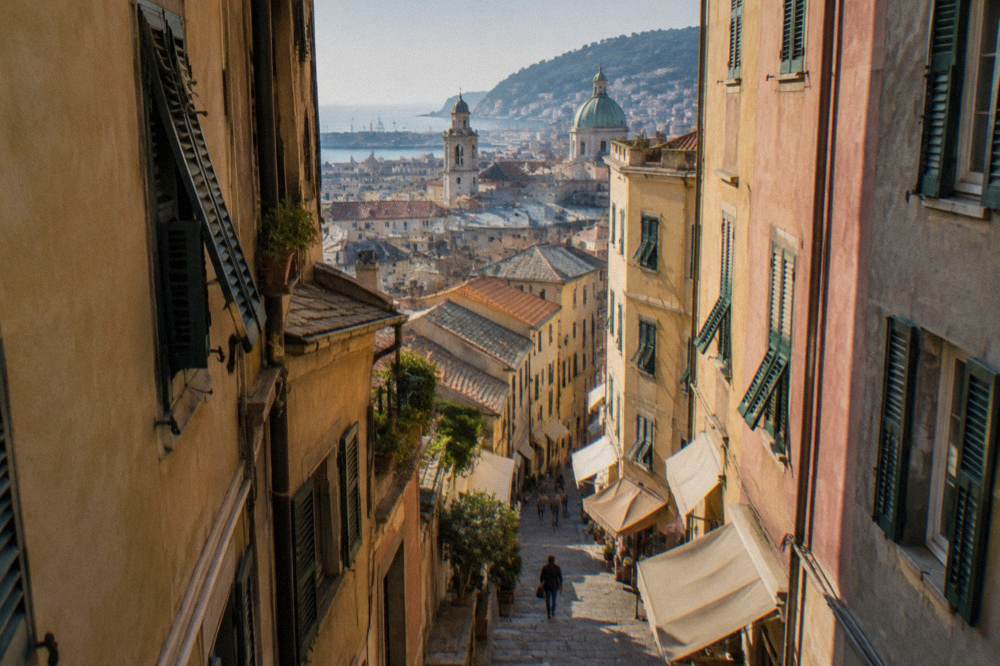
A workable farinata day pairs a morning slice in the old town with one anchor sight, an afternoon viewpoint and an evening pasta plate: the Cathedral of San Lorenzo and Palazzo Ducale sit in the medieval centre where the bakeries are, the Spianata Castelletto lift rises 57 m to a terrace view for 1.20 EUR, and the Zecca-Righi funicular runs daily 06:40 to 24:00, so the city's food quarter and its lookout points connect for the price of ordinary AMT tickets. The order matters less than the geography: the old town is one of the largest medieval historic centres in Europe at 113 hectares, and the bakeries, the cathedral and the market street Via XX Settembre all sit within it or on its edge. A food-first traveller can spend the whole day inside that triangle and still tick off the UNESCO-listed Strade Nuove, inscribed in 2006, a short walk uphill.
For the anchor sight, the choice is between the Porto Antico, with the Aquarium of Genoa open 365 days a year and adult fixed-date tickets from 26.00 EUR, and the museum quarter on and around Via Garibaldi. The Aquarium's own ticket page lists dynamic pricing, children 4 to 12 from 16.00 EUR and under-4s free, and a combined ticket with the Biosfera and the Bigo lift from 37.00 EUR for an adult. The Bigo lift alone is listed at 6.00 EUR adult. If rain moves the plan indoors, the rainy-day options are built around exactly these museums.
| Porto Antico 2026 ticket | Price |
|---|---|
| Aquarium, adult fixed-date | from 26.00 EUR |
| Aquarium, reduced (military, over 65, disabled) | from 20.00 EUR |
| Aquarium, children 4 to 12 | from 16.00 EUR |
| Aquarium, ages 0 to 3 | free |
| Aquarium + Biosfera + Bigo, adult | from 37.00 EUR |
| Bigo lift alone, adult | 6.00 EUR |
The viewpoint half of the day costs almost nothing. The Castelletto Levante lift runs daily 06:40 to 24:00 and costs 1.20 EUR a ride, the same as the Sant'Anna funicular, and it rises from Piazza Portello to the Spianata Castelletto terrace. The Zecca-Righi funicular covers the longer climb on the same ticket family. Finish with trofie or pansoti, the two pasta shapes the Genoese kitchen pairs with pesto, and the day closes the loop it opened with a slice of chickpea flatbread. Check availability on the food and wine tasting walk if you would rather have a guide connect those stops.
Which Day Trips Take You Into Flatbread Country?
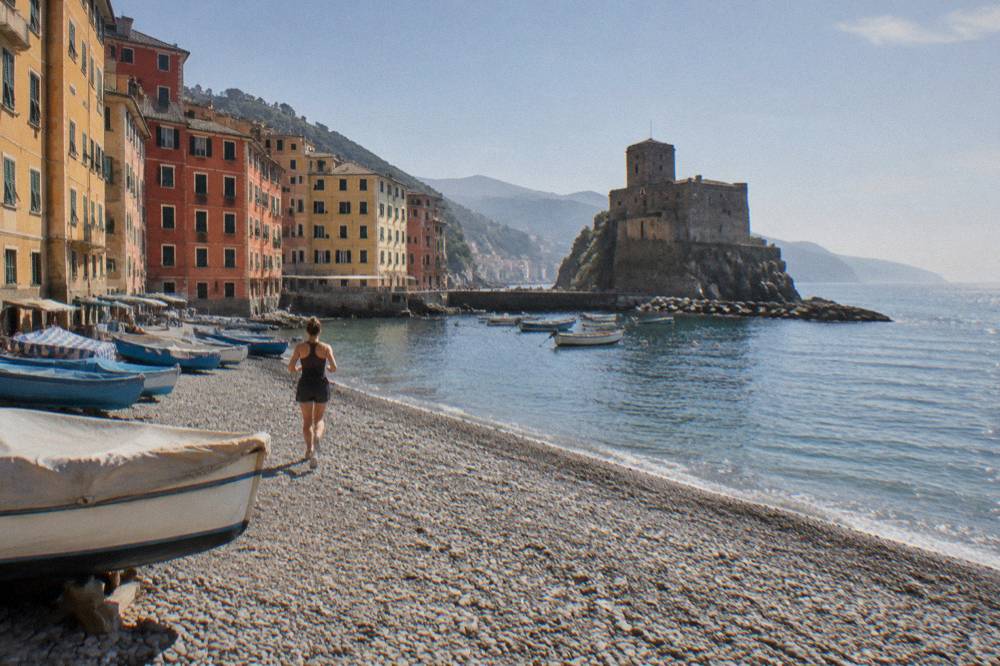
The farinata-and-focaccia day trip from Genoa runs east along the Ligurian coast: Camogli is about 18 km in a straight line, Portofino about 25 km, and the Golfo Paradiso boat operator runs its Two Gulfs tour from Genoa Porto Antico from March 2026 on listed dates, with about 30 minutes from Camogli to San Fruttuoso, while Camogli to San Fruttuoso boats run year round and the FAI abbey at San Fruttuoso charges 10 EUR full entry. The point of the trip is that the IGP zone for focaccia di Recco, Recco, Camogli, Sori and Avegno, is the same stretch of coast, so one regional train or one boat outing puts a visitor inside the protected production area of the flatbread most often confused with farinata. Fares reported by the operators: the Two Gulfs full day about 29 EUR and half day 21 to 26 EUR, Camogli to San Fruttuoso about 12 EUR return, and the Tigullio Super Cinque Terre return 47 EUR. Confirm current timetables and fares before travelling, as they are seasonal and weather-dependent.
| Coastal boat route | Reported fare | Notes |
|---|---|---|
| Two Gulfs tour, full day, Genoa Porto Antico | about 29 EUR | Stops at Camogli, San Fruttuoso, Portofino, listed dates |
| Two Gulfs tour, half day | 21 to 26 EUR | One stop |
| Camogli to San Fruttuoso, return | about 12 EUR | Year-round service |
| Santa Margherita to Portofino, return | about 20 EUR | Seasonal |
| Tigullio Super Cinque Terre, return | 47 EUR | From Rapallo and Santa Margherita Ligure |
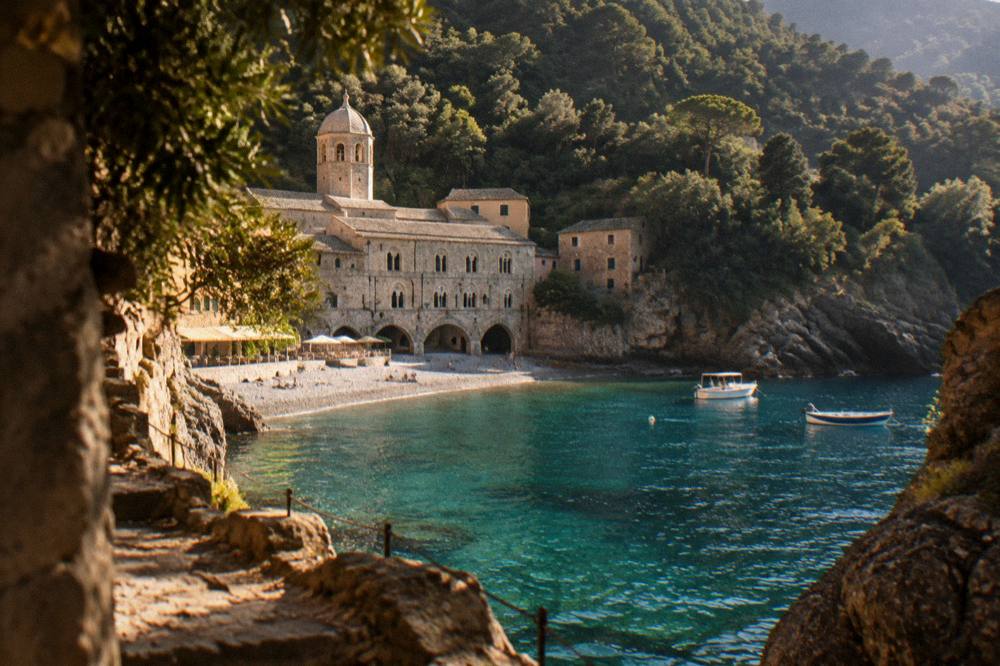
The abbey at San Fruttuoso gives the boat trip a destination with a fixed price: the FAI, Italy's heritage trust, lists full entry at 10 EUR, ages 6 to 18 and students up to 25 at 5.00 EUR, under-5s free and a family ticket at 26.00 EUR, with seasonal hours that shorten in winter. For planning the wider coast, the site's Portofino and Cinque Terre pages carry the tour options, and the Camogli guide covers the town itself. Genoa's own history is never far from the table here: the Republic lasted until 1797, and the Columbus connections, the Casa di Colombo where he lived from 1455 to 1470, stand in the same streets as the food stops, as the Christopher Columbus in Genoa page details.
When Is The Best Season For A Food Trip To Genoa?
The official 1971-2000 climate normals for Genoa Sestri show why the eating calendar matters: October averages 171.3 mm of rain and July 24.2 mm, August averages a 27.7 C mean daily high and January a 5.5 C mean daily low, so a food trip built around bakeries and boat excursions balances warmth against rain rather than chasing extremes. The full monthly picture is below, and it argues for late spring or early autumn for a trip that mixes flatbread stops with coastal boats, since September still averages a 24.4 C mean high while October more than doubles July's rainfall. The autumn calendar also brings the city's food-adjacent events: the Salone Nautico ran 1 to 6 October 2026 and runs 30 September to 5 October 2027, the Rolli Days ran 16 to 18 October 2026, and the Festival della Scienza ran 22 October to 1 November 2026.
| Month | Mean high C | Mean low C | Rain mm |
|---|---|---|---|
| Jan | 11.5 | 5.5 | 101.8 |
| Feb | 12.2 | 6.0 | 74.0 |
| Mar | 14.6 | 8.2 | 81.7 |
| Apr | 16.8 | 10.5 | 88.0 |
| May | 20.5 | 14.2 | 72.4 |
| Jun | 23.9 | 17.6 | 58.2 |
| Jul | 27.3 | 20.9 | 24.2 |
| Aug | 27.7 | 21.0 | 69.3 |
| Sep | 24.4 | 17.9 | 136.4 |
| Oct | 20.0 | 13.8 | 171.3 |
| Nov | 15.1 | 9.2 | 108.8 |
| Dec | 12.5 | 6.5 | 93.1 |
The seasonal note that concerns food specifically is the boat season. The Golfo Paradiso tours from the Porto Antico run from March on listed dates, the Camogli to San Fruttuoso service runs year round with more frequent sailings from April to September, and the abbey's hours shorten after summer. If the trip is really about eating your way down the coast, the window from late April to early October covers both the flatbread counters and the boats that connect them. For the fuller planning picture, see Genoa weather and the best time to visit Genoa.
Common Questions About Farinata In Genoa
What is farinata genovese made of?
Chickpea flour, water, olive oil and salt, mixed into a loose batter and baked quickly in a very hot wood-fired oven. It contains no yeast or other leavening, which is what separates it from focaccia.
Is farinata the same as focaccia?
No. Farinata is an unleavened chickpea flatbread; focaccia is a leavened wheat dough. Focaccia di Recco is a third thing again, two thin dough layers with a soft cheese filling, protected by IGP since 2015 and produced only in Recco, Camogli, Sori and Avegno.
Where should I eat farinata in Genoa?
This site prints no restaurant or bakery names or rankings. The practical approach is the old town, whose medieval centre covers 113 hectares and concentrates the bakeries; a guided food walk covers the ordering and the stops, and the tour blocks on this page show current prices and ratings.
How much does a food trip to Genoa cost?
Beyond the tour prices shown in the blocks above, the fixed 2026 visitor costs are the tourist tax, from 2.00 to 5.00 EUR per person per night by category, and transport at 2.00 EUR for a 110-minute AMT ticket or 10.00 EUR for a 24-hour Met Daily. Dish and bakery prices are not published by official sources, so check prices where you buy.
Can I combine farinata with a coastal day trip?
Yes. The Golfo Paradiso Two Gulfs boat tour runs from Genoa Porto Antico from March on listed dates, Camogli to San Fruttuoso boats run year round, and the FAI abbey at San Fruttuoso charges 10 EUR full entry. The Recco IGP zone for focaccia di Recco is the same stretch of coast.
Are there cooking classes that teach the Genoese food traditions?
Yes, the site's roster includes pesto and fresh pasta classes, including a mortar pesto lesson and a rooftop class, alongside food tours with tastings. Durations, prices and ratings render in the tour blocks on this page; check the operator's live listing for current availability and cancellation terms.
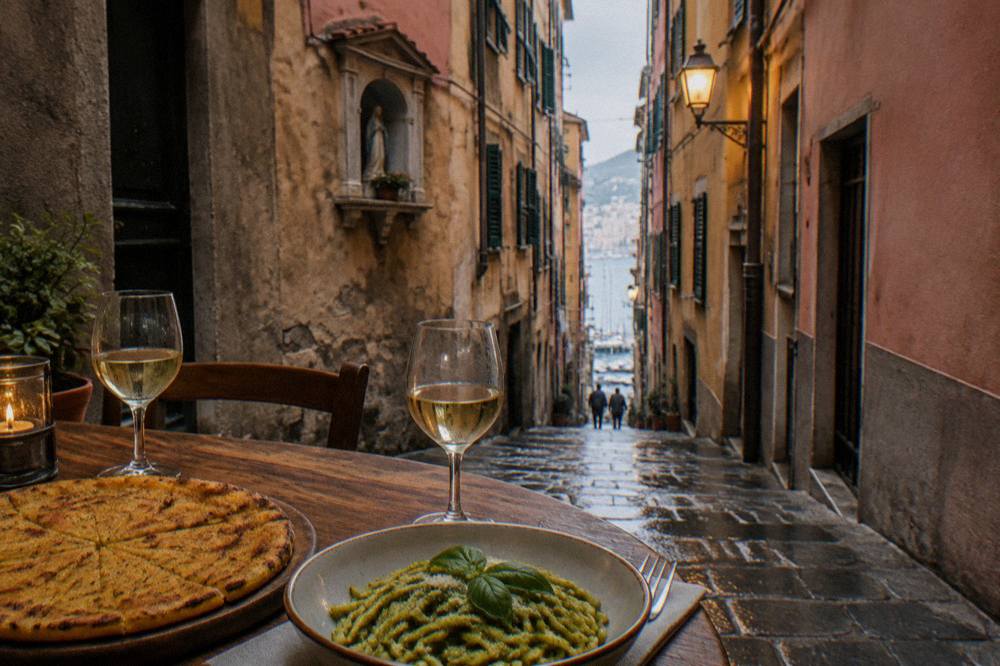
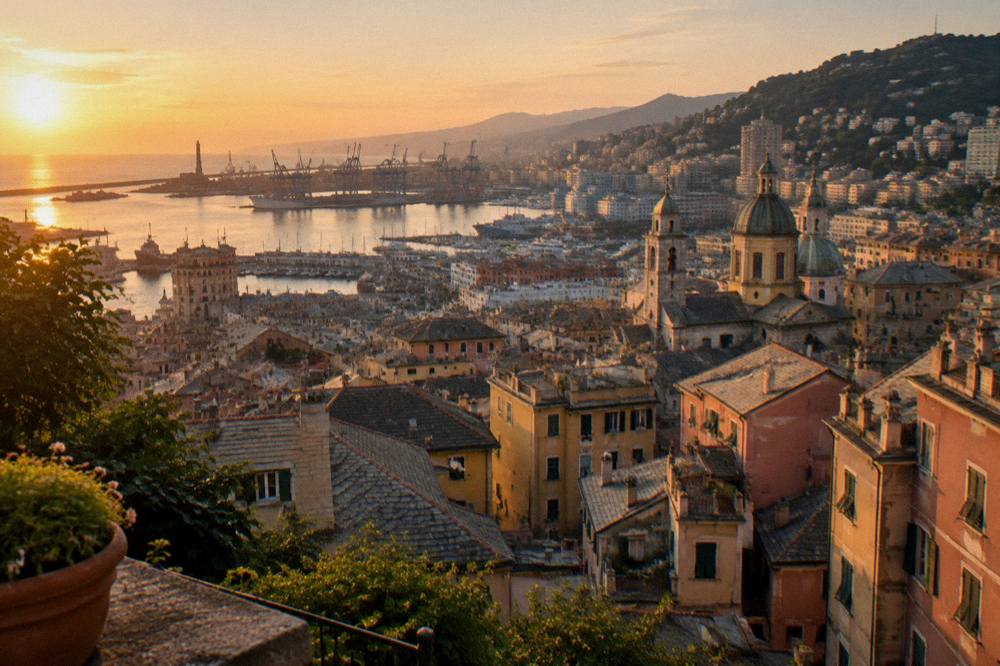
Farinata is the simplest object in the Genoese kitchen and the quickest way into it: one pan, four ingredients, a wood oven, and a city of bakeries that has treated that formula as seriously as its PDO basil and its IGP flatbread down the coast. Build the day around a warm slice, a viewpoint reached for 1.20 EUR, and an evening plate of trofie, and the rest of the table, from pesto genovese to focaccia di Recco, arranges itself around it.