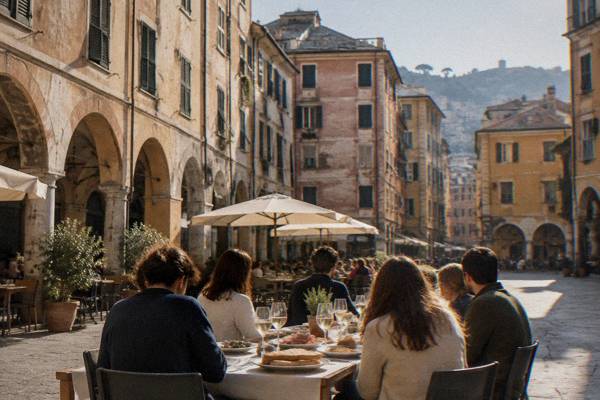
Focaccia Genovese: The Best Bakeries And How Locals Eat It
Focaccia genovese is the everyday bread of Genoa, a coastal city in Liguria, north-west Italy: a soft, olive-oil-rich flatbread sold by weight and eaten at any hour. Here is what it is, how it differs from the cheese-filled focaccia di Recco, and how to plan a food day around both.
Short answer
Focaccia genovese is a soft, dimpled flatbread enriched with olive oil and salt, sold by weight in bakeries across Genoa and eaten as a snack or breakfast. Its protected cousin, focaccia di Recco, is a thin double crust filled with cheese and holds IGP status since 2015.
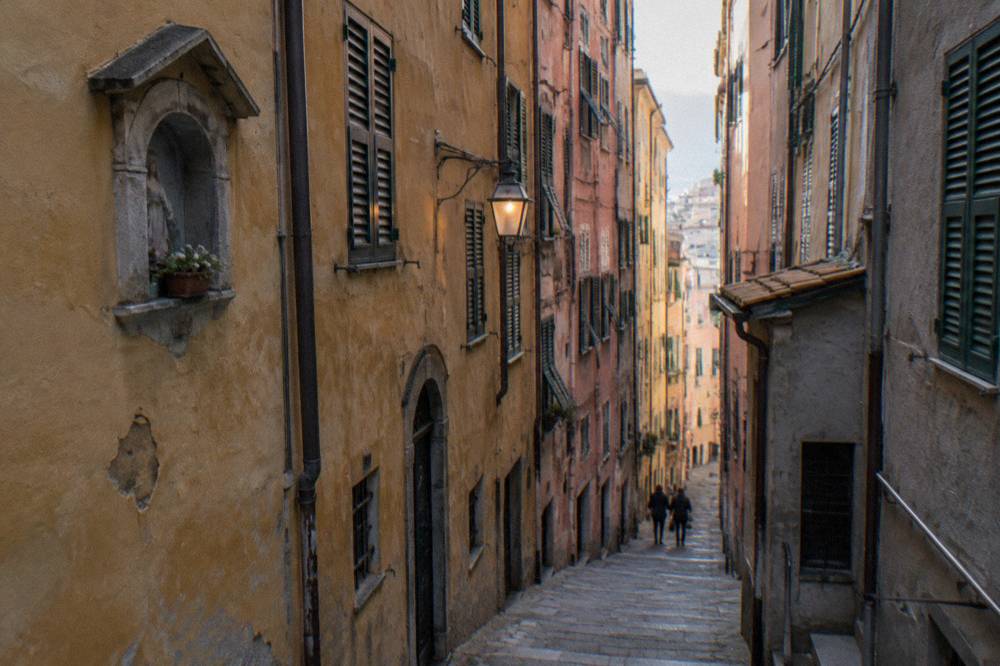
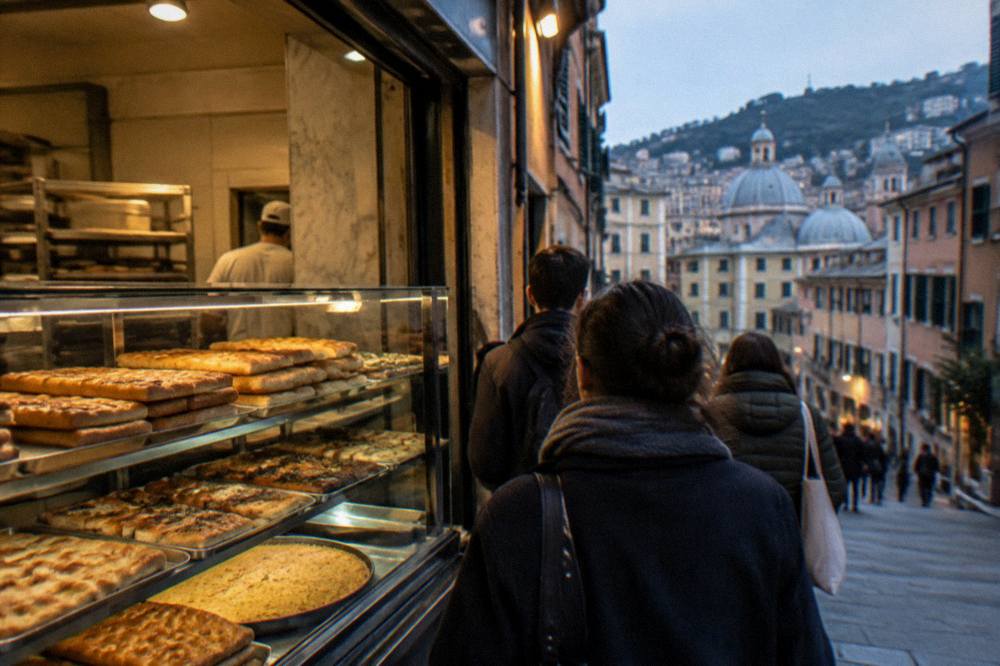
Genoa, the coastal city in Liguria on the Ligurian Sea, runs on bread and oil the way other cities run on coffee bars and sandwich shops. The local flatbread, focaccia genovese, appears in bakery windows from the caruggi of the old town to the seafront at Corso Italia, cut from big rectangular trays, weighed, wrapped in paper and handed over still warm. This page explains what the bread is, how it differs from its protected cousin the focaccia di Recco, how to order it without guesswork, and how to fold it into a wider food itinerary in a city whose cooking also gave the world pesto genovese.

What Is Focaccia Genovese?
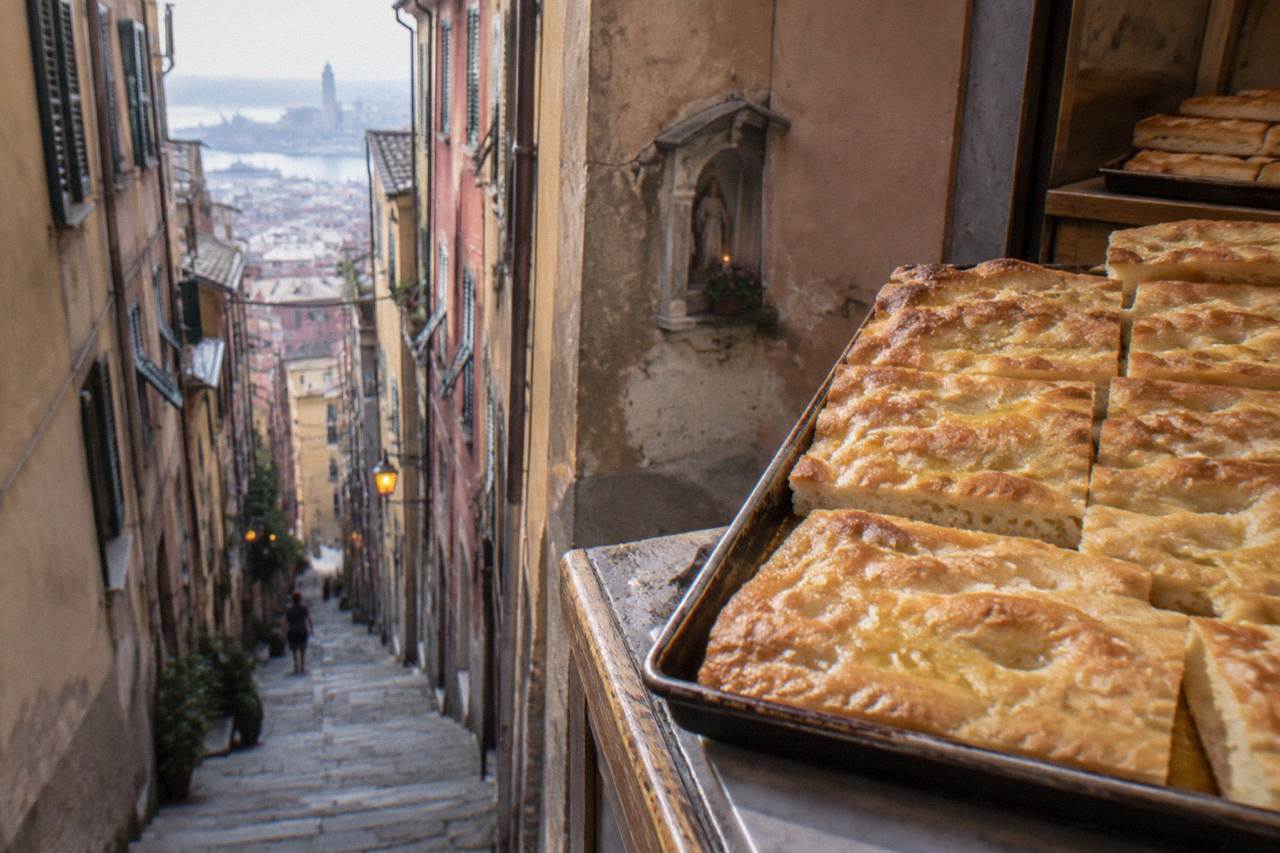
Focaccia genovese is the city's everyday flatbread: a low, soft loaf dimpled across its surface, soaked with olive oil and finished with coarse salt, baked in shallow rectangular trays and sold by weight rather than by the piece. In Genoa it functions as breakfast, mid-morning snack and street food at once, and it is distinct from both the cheese-filled focaccia di Recco and the chickpea farinata sold in the same bakeries.
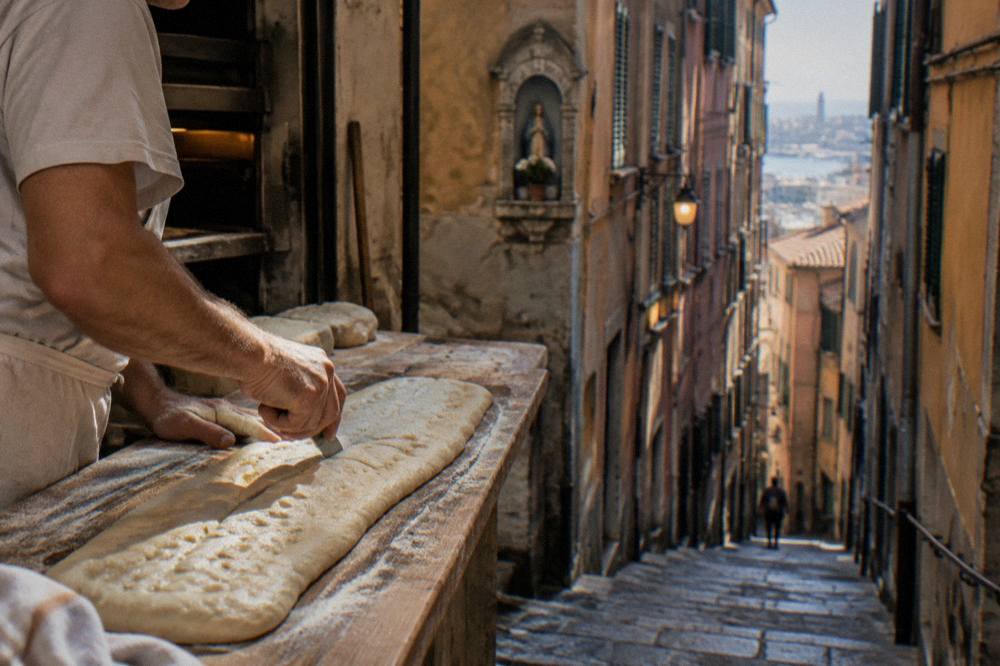
The bread itself is simple in the way that only a short ingredient list can be. Dough, water, olive oil and salt produce a pale golden top punctured by finger dimples that hold pools of oil. The underside should be lightly greased, almost fried, from the oiled tray. A tray comes out of the oven, cools for a short while on the counter, and is then cut with a scraper to the size a customer asks for.
Two things distinguish buying it in Genoa from buying "focaccia" anywhere else. First, it is treated as a default rather than a specialty: the pans are baked in continuous rotation through the morning. Second, it belongs to a family of oven goods rather than standing alone. The same bakery that sells focaccia genovese will usually sell farinata, the thin savoury chickpea pancake covered on our farinata guide, and in the eastern Ligurian towns, the cheese-filled focaccia di Recco.
For context on the wider table, our pesto genovese guide covers the sauce that shares the city's name, and the what to eat in Genoa guide places the bread among trofie, pansoti and farinata as the pillars of local eating.
Focaccia Genovese Or Focaccia Di Recco: What Is The Difference?
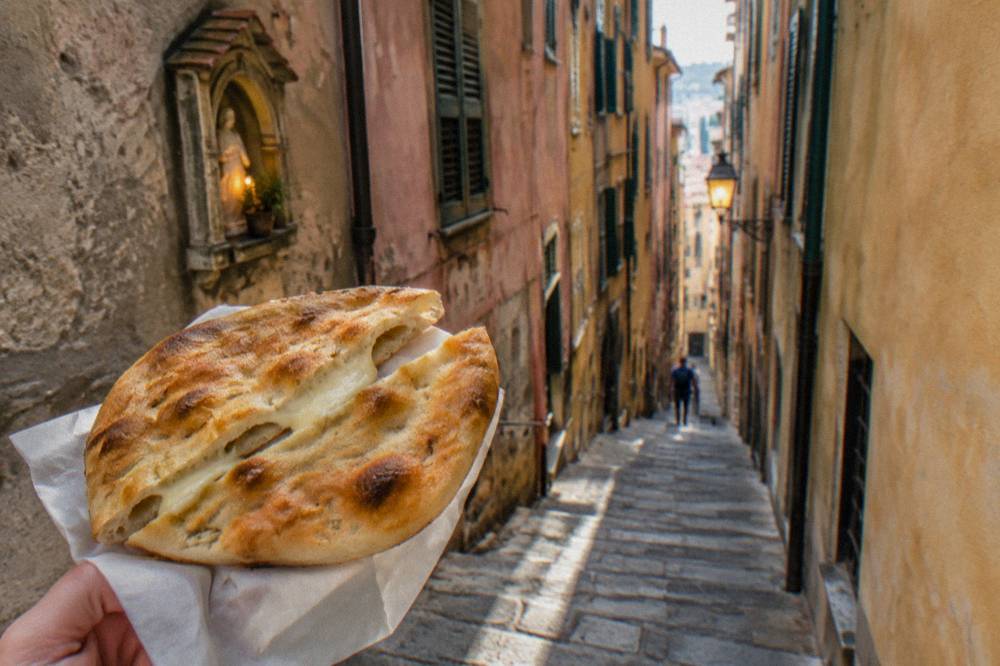
Focaccia genovese is a thick, soft, dimpled flatbread seasoned only with olive oil and salt, eaten any day in Genoa itself. Focaccia di Recco is a different product entirely: two paper-thin sheets of dough with a molten cheese layer between them, protected by IGP status since 2015 and produced only in Recco, Camogli, Sori and Avegno, the towns east of the city on the Ligurian coast.
The confusion comes from the shared word. Visitors order "focaccia" in Genoa expecting the blistered, cheese-filled Recco version and receive the city's own soft bread instead. Both are legitimate, both are centuries of local oven craft, but they are as different as a loaf and a pie.
| Focaccia genovese | focaccia di Recco | |
|---|---|---|
| Where it belongs | Genoa and its province | Recco, Camogli, Sori and Avegno only |
| Protection | None | IGP since 2015 |
| Form | Thick, soft, dimpled flatbread | Two thin crusts with cheese between them |
| Seasoning | Olive oil and coarse salt | Cheese filling, minimal oil |
| Sold by | Weight, cut from the tray | Whole round pans or by the portion |
The practical consequence for a trip is geography. The IGP rules tie the Recco bread to four towns, so the genuine article sits east of the city along the coast, reached by regional train or by boat. Camogli lies about 18 km in a straight line from Piazza De Ferrari, Portofino about 25, and Santa Margherita Ligure about 24, which makes a single coastal day trip capable of covering the bread's home territory and some of the most photographed coastline in Italy. Our day trip guide to Recco covers the practical side.
Where To Find Good Focaccia In Genoa?
In Genoa, focaccia genovese is bought at panetterie and forni, the city's bakeries, which sell it by weight from rectangular trays, and the reliable signal of a good one is turnover: a bakery selling out tray after tray through the morning is baking continuously rather than holding stock. The old town around Via XX Settembre and the Mercato Orientale area has the densest run of bakeries, and no single named shop holds an official crown.
The honest answer about "the best" bakery is that no ranking exists that this site could stand behind, and the fun of the search is that the bread is cheap enough to try several in a morning. What can be said with confidence is structural. Bakeries cluster where footfall clusters. The streets around the Mercato Orientale on Via XX Settembre, the market itself as a place name, and the lanes of the old town give a visitor the highest number of trays per block.
A useful approach is to treat the search as a walk rather than a pilgrimage. Start wherever the first warm tray presents itself, note the weight-based pricing, and compare. Some trays run pale and soft, others darker and crisper at the edge, and preference between them is exactly the kind of thing a short walking comparison settles better than any list.
| Signal at the counter | What it tells you |
|---|---|
| Trays coming out of the oven in rotation | High turnover, fresh bread |
| Oil pooled lightly in the dimples | The tray was oiled properly |
| Sold by weight, cut to size | Standard Genoa practice |
| Wrapped in paper without a bag | Normal for eating on the street |
For travellers who would rather have the bakery landscape decoded by someone who works with it, the food tours on this site do exactly that, and the featured one walks a small group through the old town with a full meal built in. The tour has its own page here, and you can Check availability on the operator's live listing.
Wait, correct the image to a real description.
How Do You Order Focaccia In Genoa?
Ordering focaccia in Genoa runs on weight and simple Italian words: point at the tray, indicate a size with your hands or ask for a small piece, and the baker cuts, weighs and wraps it in paper on the spot. There is no queue system to learn and no ticket machine, just the counter, the tray and a scale, and the bread is eaten with the hands, warm, within minutes of buying it.
The vocabulary is short. "Focaccia" alone gets you the city bread. Asking for "una fetta" or indicating with your fingers gets you a piece. If you want more, ask for "mezzo chilo", half a kilo, which is a quantity that makes sense for a group. The baker will often ask whether you want it "calda", warm, meaning from a recent tray if one exists.
Eating it is equally direct. The paper wrap exists so the bread can be eaten standing or walking. In the Genoese tradition the mid-morning is the bread's natural slot, alongside the equally casual farinata, though nothing stops an earlier or later piece. For a fuller picture of how the city structures its eating day, the Genoa restaurants guide covers sit-down meals, and the what to eat in Genoa guide covers the rest of the street food.
Getting between bakery streets is cheap. An AMT ticket is 2.00 EUR and valid 110 minutes on the whole urban network, and the Met Daily at 10.00 EUR covers a full day including the airport Volabus.
| Ticket | Price | Validity |
|---|---|---|
| AMT ordinary ticket | 2.00 EUR | 110 minutes, whole network |
| AMT and Trenitalia integrated | 2.20 EUR | 110 minutes including regional trains |
| Carnet of 11 tickets | 20.00 EUR | 11 x 110 minutes |
| Met Daily | 10.00 EUR | 24 hours, full AMT network |
Can You Learn To Make Focaccia Genovese In Genoa?
Yes, and it is one of the more rewarding ways to spend a half day in the city: Genoa has a strong roster of cooking classes covering pesto, fresh pasta and Ligurian breads, taught in rooftop and home-kitchen settings, where the dough work, the oiling of the tray and the dimpling technique are demonstrated hands-on before you eat what you made. The classes run small and book out ahead in the warmer months.
The class route suits travellers who want more than photographs. Working the dough by hand teaches why the bread's crumb is so open and why the oil matters at every stage. Several of the classes on this site pair the bread work with pesto made by mortar, which is the other signature skill of the Genoese kitchen, and some finish with a full shared meal. The rest of the planning pages sit on Genoa Travel Guide.
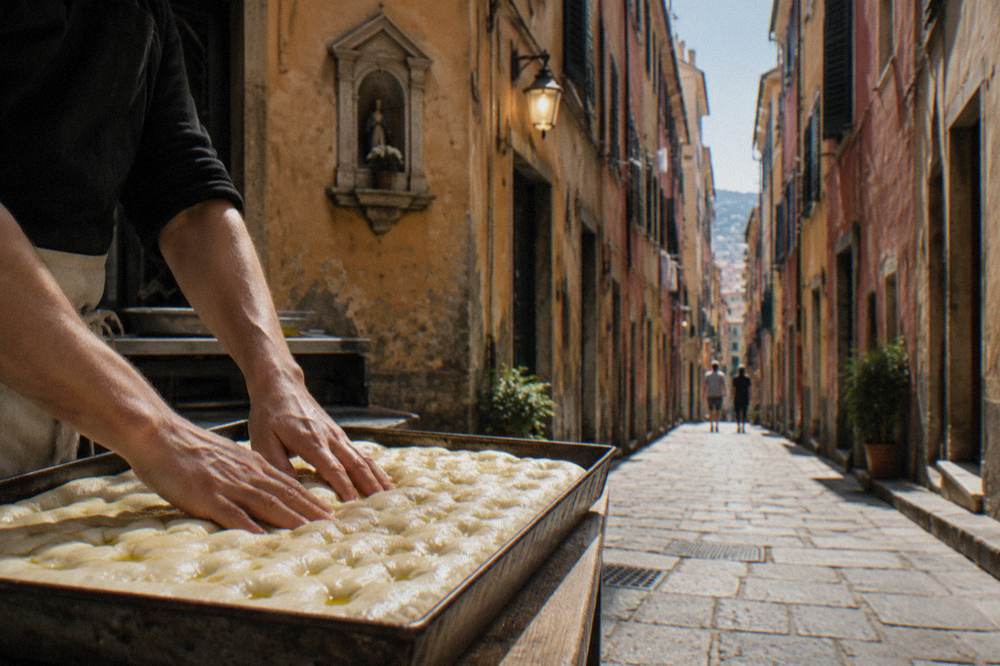
Between the bakery walk and the class, the bread has a way of pulling the whole city's food culture into one thread: the olive oil, the basil for the pesto, the chickpea flour for the farinata, the cheese of the Recco coast. A good sequence for a longer stay is one day of bakery comparison, one class morning, and one coastal day trip east.
Is A Trip To Recco Worth It For The Focaccia Di Recco?
Yes, if the cheese-filled focaccia is a priority, because the IGP protection means the authentic version comes only from Recco, Camogli, Sori and Avegno, all within a short regional train ride east of Genoa along the coast. Camogli sits about 18 km in a straight line from Piazza De Ferrari, and the boat line from Camogli runs to San Fruttuoso year round, so the bread can anchor a full coastal day rather than a detour.
The train is the practical spine. Regional services run along the coast from Genova Piazza Principe and Genova Brignole toward the eastern Riviera towns, and the same line continues toward Sestri Levante, about 40 km in a straight line, and the Cinque Terre beyond. On the water side, the Golfo Paradiso operator runs its Two Gulfs tour from Genoa Porto Antico on listed dates from March, calling at Camogli around 11:45, with crossings of about 30 minutes between Camogli, San Fruttuoso and Portofino.
| Coastal stop | Straight-line distance from Piazza De Ferrari |
|---|---|
| Camogli | about 18 km |
| Santa Margherita Ligure | about 24 km |
| Portofino | about 25 km |
| Sestri Levante | about 40 km |
In Camogli the focaccia di Recco shares the stage with the harbour and the waterfront, and the same town serves as the departure point for the boat to San Fruttuoso, where the FAI-run abbey charges 10 EUR full entry, 5 EUR for visitors aged 6 to 18 and students to 25, free under 5. The abbey keeps seasonal hours, so confirm the day's boat timetable before committing to the itinerary. Our Camogli coverage and the wider guides to Santa Margherita Ligure and the coast help with planning.
What Else Should You Eat In Genoa Beyond Focaccia?
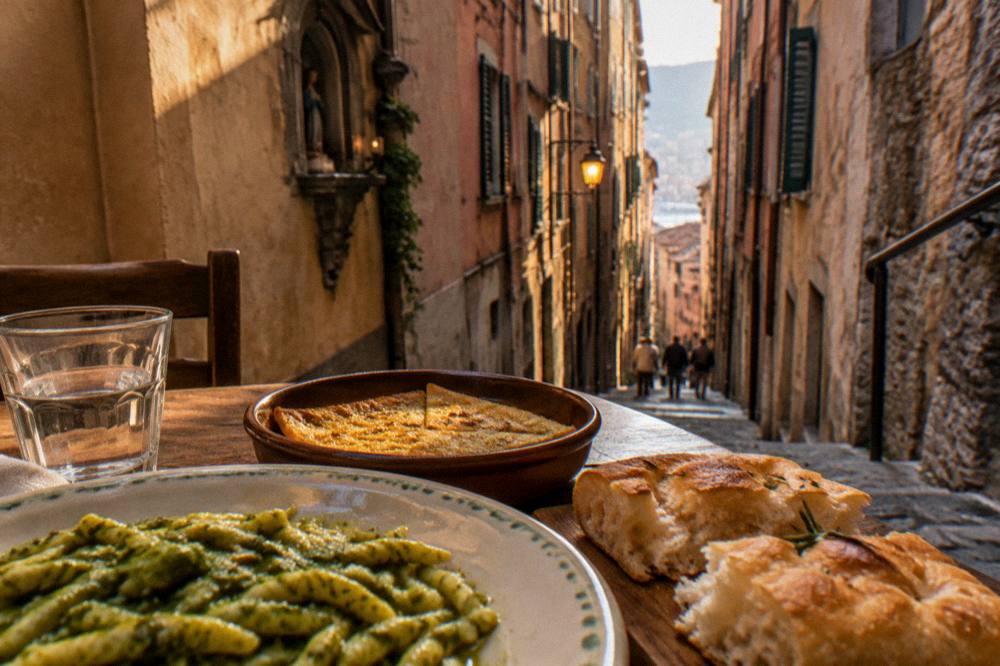
The city's table beyond focaccia runs through pesto genovese made with Basilico Genovese PDO basil, trofie pasta twisted to hold the sauce, pansoti filled pasta with a walnut sauce, and farinata cooked in a wood oven, and all of them sit within walking distance of the same bakery streets. A food day can move from a morning focaccia to a market wander and a pesto-first lunch without repeating itself.
The dishes are few and tightly linked. Pesto is the headline, and its basil is a protected product, which is why the sauce tastes different here. Trofie are the pasta shape built for it. Pansoti are the vegetarian filled pasta of the local tradition. Farinata is the chickpea flatbread that shares oven space with the focaccia and divides the city into loyalists of one or the other.
| Dish | What it is | Covered on |
|---|---|---|
| Pesto genovese | Basil, pine nut and cheese sauce made with Basilico Genovese PDO | Pesto guide |
| Focaccia genovese | Soft dimpled olive oil flatbread | This page |
| focaccia di Recco | Thin double crust with cheese, IGP since 2015 | This page |
| Farinata | Thin chickpea pancake baked in a wood oven | Farinata guide |
| Trofie | Small twisted pasta served with pesto | What to eat guide |
| Pansoti | Filled pasta with walnut sauce | What to eat guide |
For travellers who arrive with a list of names from television, the answer on where Stanley Tucci ate in Genoa addresses that itinerary directly. And for anyone building a full first visit around the food, the things to do in Genoa page places the bakery walks among the Aquarium, the Strade Nuove palaces and the Lanterna.
How Do You Build A Focaccia Day Around The Rest Of Genoa?
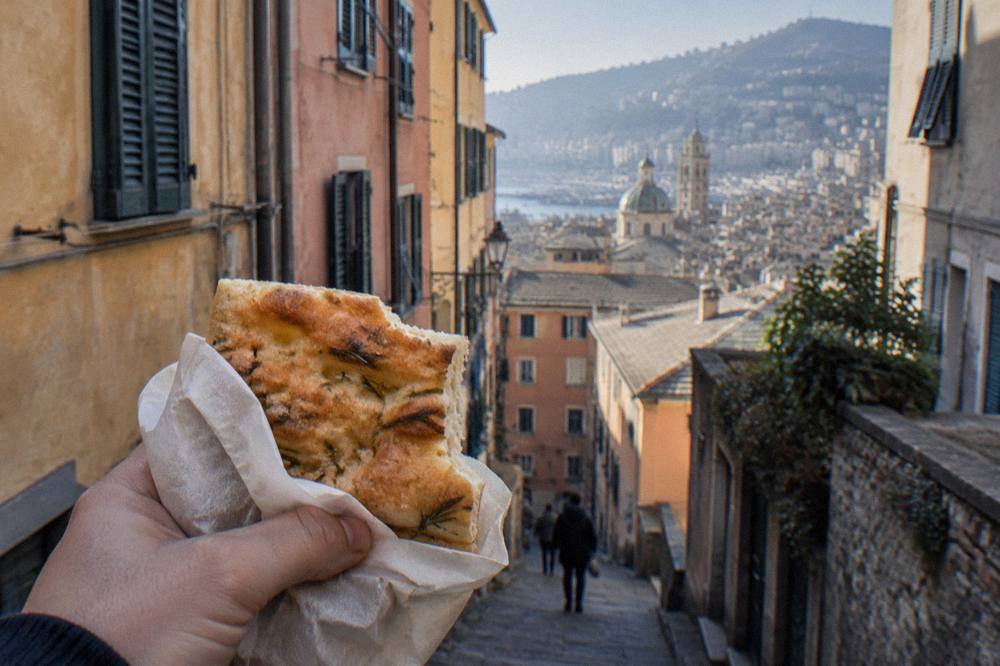
A focaccia day pairs naturally with the sights within walking distance of the bakery streets: the old town and the caruggi, Piazza De Ferrari, the Strada Nuove museums and the Porto Antico with the Aquarium are all reachable on foot or with a 2.00 EUR AMT ticket, so the bread stops can be folded into a conventional sightseeing day without rebuilding the itinerary around them.
One workable shape: a morning bakery stop in the old town, a walk through the caruggi toward the Cathedral of San Lorenzo, then up Via Garibaldi to the Musei di Strada Nuova, which in the winter timetable from 28 September 2026 to 18 April 2027 open daily 10:00 to 18:30, with only Palazzo Rosso visitable on Mondays. The combined ticket with the Museo di Sant'Agostino is 14 EUR full, 9 EUR reduced, and the Genoa Museum Card at 24 EUR for 24 hours or 45 EUR for 48 hours covers 28 city museums.
The afternoon can drift down to the Porto Antico, where the Aquarium of Genoa opens 365 days a year with adult fixed-date tickets from 26.00 EUR and the combined Aquarium, Biosfera and Bigo ticket from 37.00 EUR. Our Aquarium tickets guide and the Museum Card guide carry the full price detail. A final focaccia or farinata stop on the way back through the old town closes the loop.
Weather barely disrupts the plan, and the official 1971-2000 normals for Genoa Sestri put the mean daily high at 20.0 C in October and 11.5 C in January, so the bread walk works year round. Rain totals run higher in October than any other month at 171.3 mm, which is worth knowing for the coastal leg to Recco, and the Genoa weather guide has the month-by-month table.
| Month | Mean daily high | Mean daily low | Rain |
|---|---|---|---|
| January | 11.5 C | 5.5 C | 101.8 mm |
| April | 16.8 C | 10.5 C | 88.0 mm |
| July | 27.3 C | 20.9 C | 24.2 mm |
| October | 20.0 C | 13.8 C | 171.3 mm |
Common Questions About Focaccia Genovese
These are the questions readers ask about focaccia genovese in Genoa, answered with the facts this site holds: what the bread is, how it differs from focaccia di Recco, what it costs to reach the bread towns, and how to eat it the way the city does. Each answer is short and stands alone.
What Is The Difference Between Focaccia Genovese And Focaccia Di Recco?
Focaccia genovese is a thick, soft, dimpled flatbread with olive oil and salt, sold by weight in Genoa's bakeries. Focaccia di Recco is a thin double crust filled with cheese, protected by IGP status since 2015 and produced only in Recco, Camogli, Sori and Avegno.
Can You Buy Focaccia Di Recco In Genoa Itself?
The IGP protection ties the authentic cheese-filled focaccia to Recco, Camogli, Sori and Avegno, so the genuine article belongs to the coastal towns east of the city, reached by regional train. Genoa's own bakeries sell the city's soft focaccia genovese and usually farinata.
How Is Focaccia Sold In Genoa Bakeries?
By weight, cut from rectangular trays to the size you indicate, and wrapped in paper for eating on the street. There is no fixed portion and no official price list this site can print, so expect the scale at the counter to settle the amount.
What Is Focaccia Di Recco Called Locally?
In its home towns the protected bread is also known by its plain descriptive name as a cheese focaccia, a thin double sheet of dough with a molten cheese layer, and the IGP mark is the reliable signal of the authentic version.
What Else Should You Eat Alongside Focaccia In Genoa?
Pesto genovese made with Basilico Genovese PDO basil, trofie pasta, pansoti with walnut sauce and farinata are the other pillars of the local table, and all are covered in the site's pesto, farinata and what-to-eat guides.
Is Focaccia In Genoa A Breakfast Food Or A Snack?
Both, in practice. The bread is baked through the morning and eaten warm at any hour, standing or walking, and no rule attaches it to one slot in the day.