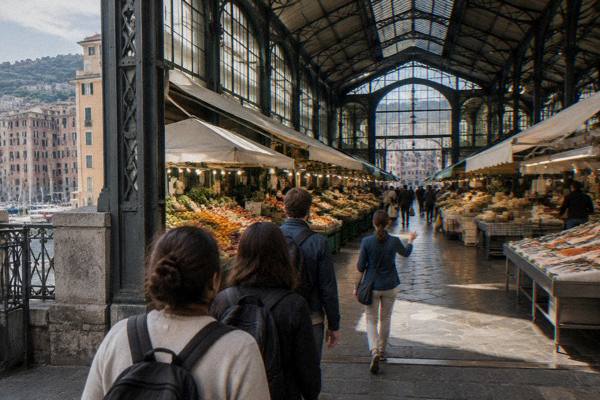
Mercato Orientale: The Covered Market On Via XX Settembre
The Mercato Orientale is the covered market that opens onto Via XX Settembre, Genoa's main shopping street, in the coastal city of Liguria in north-west Italy. This guide covers how to reach it, the food Genoa is famous for, and what a visit adds to a city break.
Short answer
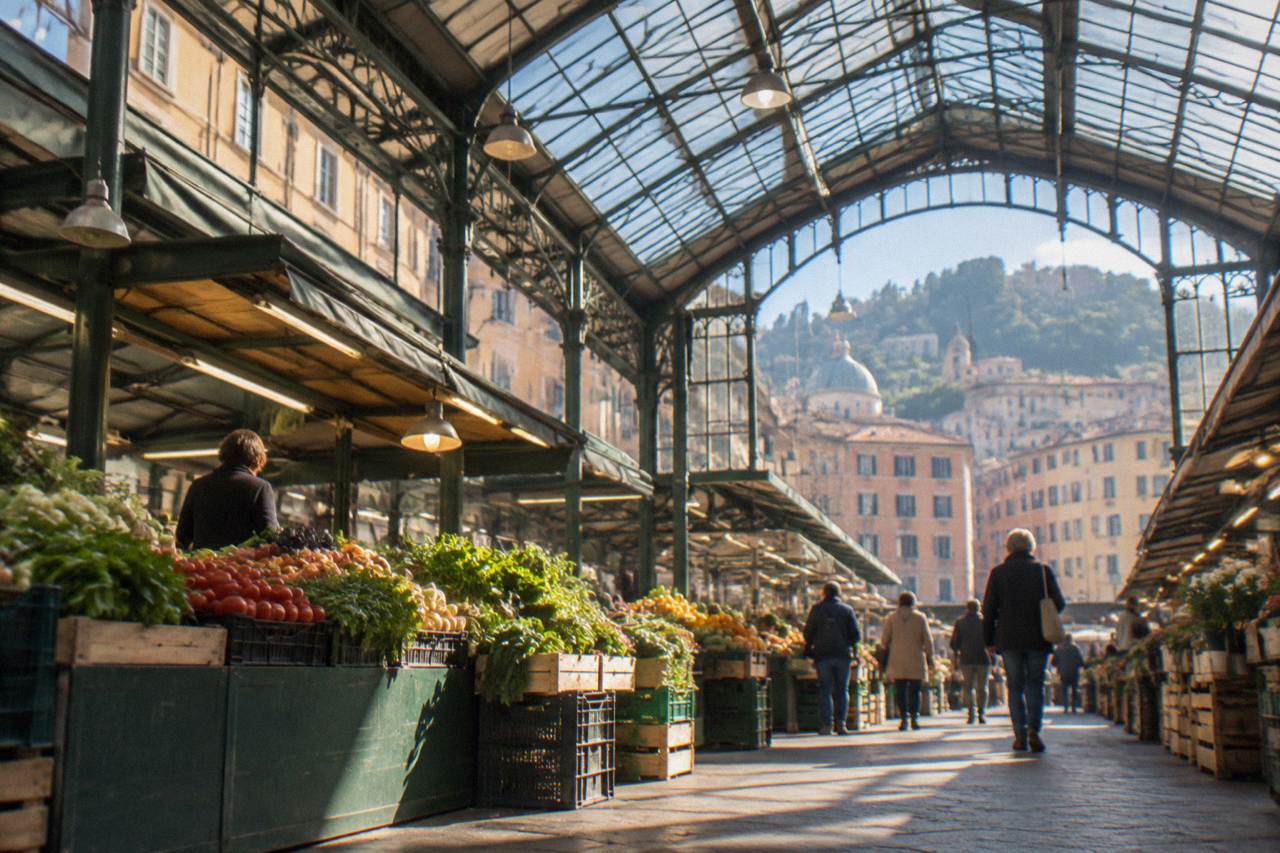
The Mercato Orientale is a covered market on Via XX Settembre in central Genoa, reachable with a 2.00 EUR AMT ticket valid 110 minutes. It pairs naturally with the street's shops, Piazza De Ferrari and the city's pesto, focaccia and farinata traditions.
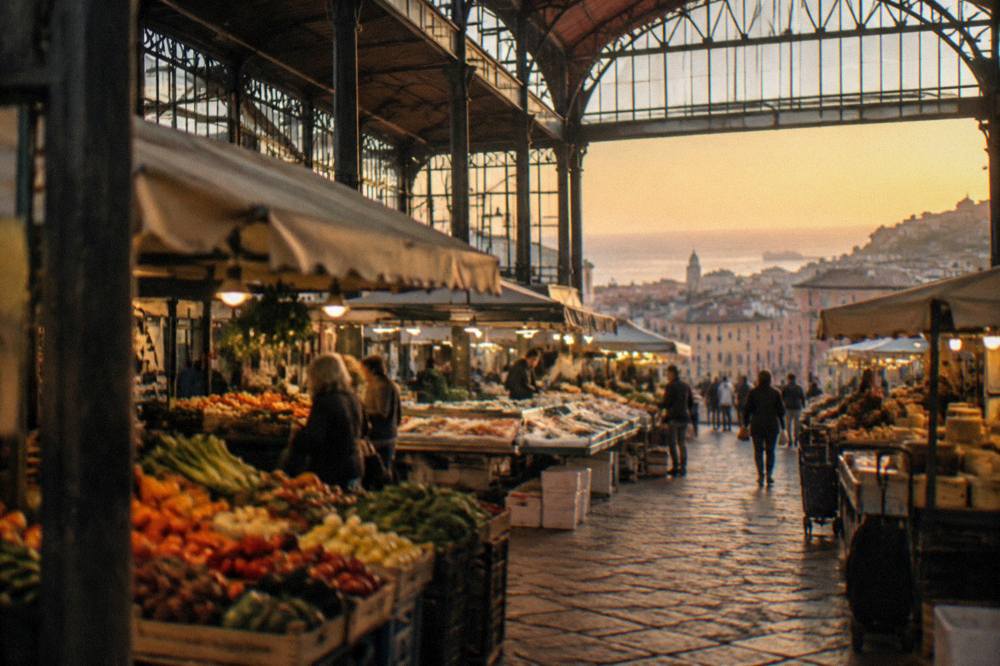
The Mercato Orientale is the covered market that opens onto Via XX Settembre, the main shopping street of Genoa, the coastal city in Liguria, north-west Italy, squeezed between the Ligurian Sea and the Apennine hills. The street itself is one of the city's modern axes, running toward Piazza De Ferrari, and the market sits at the heart of the city's food shopping life. This page gathers details of the market's location, the city's famous foods, the transport that serves the area, and the guided food experiences that pair well with a market stop.
What Is The Mercato Orientale In Genoa?
The Mercato Orientale is a covered market on Via XX Settembre in central Genoa, a city of 566,247 residents in the Comune di Genova as of 1 January 2026, reported from ISTAT data. It is a place name the city's own tourism materials attach to the street's food shopping tradition, and this page reports only what the primary sources state about it, without inventing opening hours, stall lists or vendor names.
Via XX Settembre is the wide shopping street that links the area near Piazza De Ferrari toward the east of the centre, and it is the street the market is named for. The city tourism office lists the street among Genoa's shopping addresses, alongside Genoa shopping options covered in a separate guide. The market's role in the city is as a food destination: the dishes that define Genoese cooking, pesto genovese, focaccia, farinata, trofie and pansoti, all depend on the produce of Liguria, and a covered market is where that produce is sold.
Gaps in the facts are left open rather than filled with plausible detail. Restaurant, bar, bakery and café names are left unstated, as are dish prices, and the market's own schedule is not given. The geography, the transport, the food traditions of the city and the prices of the public network that gets you there are treated properly below.
The market also sits inside a city with an exceptional weight of history around it. Genoa's old town, about 113 hectares, is described by the city's own tourism site as one of the largest medieval historic centres in Europe, and the UNESCO site "Genoa: Le Strade Nuove and the system of the Palazzi dei Rolli" inscribes 42 palaces a short walk west of the market's street. A morning at the market and an afternoon among the palaces is a realistic shape for a day, and the itineraries this site publishes, starting from things to do in Genoa, build exactly that kind of day.
How Do You Get To The Mercato Orientale In Genoa?
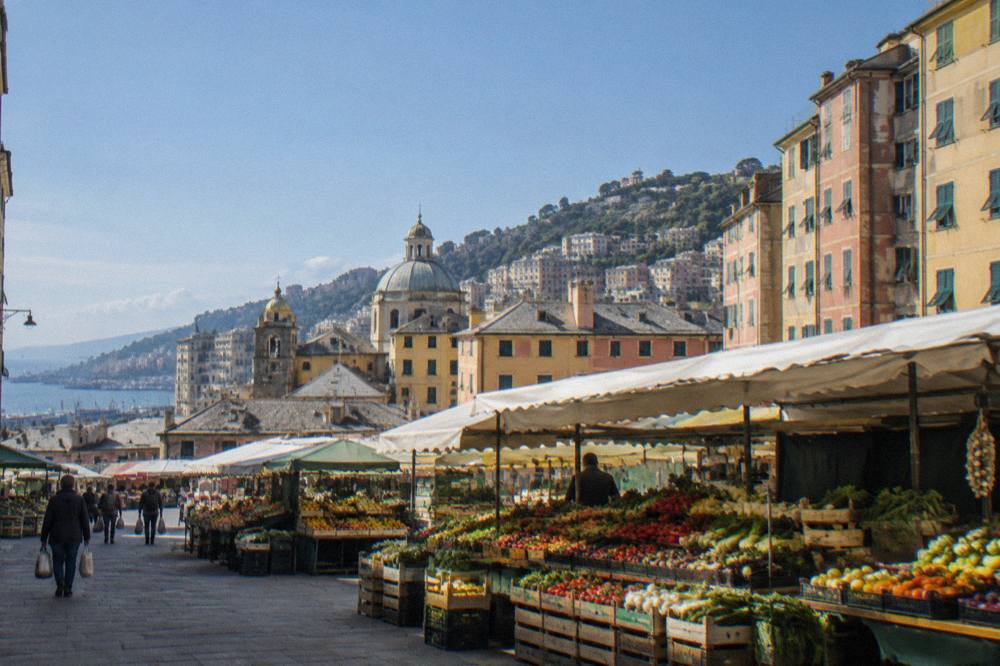
A single AMT ticket costs 2.00 EUR and is valid 110 minutes on the whole urban and metropolitan network, including buses, the metro and the funiculars, per the AMT fare table. The metro runs 7 km with 8 stations from Brin to Brignole, and Genova Brignole station sits at the eastern end of Via XX Settembre, the street the market opens onto, so the market is served by the same network that serves the whole city.
The AMT network is the practical answer for reaching the market from anywhere in the city. The ordinary ticket is bought via the AMT app, by SMS, with contactless payment on board, from machines or from retailers, and it covers 110 minutes of travel including changes. An integrated AMT and Trenitalia version costs 2.20 EUR for the same 110 minutes with limited Trenitalia travel added, useful if you arrive on a regional train.
| AMT ticket | Price | Validity and coverage |
|---|---|---|
| Ordinary single | 2.00 EUR | 110 minutes, whole urban and metropolitan network, excludes Volabus, Navebus, FGC and line 782 |
| AMT and Trenitalia integrated | 2.20 EUR | 110 minutes, urban network plus limited Trenitalia travel |
| 5-hour ticket | 5.00 EUR | 5 hours on the urban network |
| Carnet of 11 singles | 20.00 EUR | 11 x 110-minute tickets, 22.00 EUR integrated |
| Met Daily 24h | 10.00 EUR | 24 hours, full AMT network including Volabus and line 782 to Portofino |
| Lifts and Sant'Anna funicular | 1.20 EUR | One ride on the public lifts or the Sant'Anna funicular |
The metro's eight stations are Brin, Dinegro, Principe, Darsena, San Giorgio, Sant'Agostino, De Ferrari and Brignole. De Ferrari serves the western end of Via XX Settembre near Piazza De Ferrari, and Brignole serves the eastern end, so the street and its market are bracketed by two metro stations. The metro does not yet reach Canepari or Martinez: those extensions are reported as targeted forJune 2027 and December 2028 respectively, per reported updates on the works.
If you arrive at Genova Cristoforo Colombo airport, the Volabus connects the airport with Principe, De Ferrari and Brignole in about 30 minutes, and there is no single Volabus fare: the bus requires the 10.00 EUR Met Daily 24-hour ticket, which then covers the whole AMT network for the rest of the day. A taxi from the airport to the centre is a fixed 25 EUR per car, 30 EUR for more than four people, plus 2 EUR at night and on holidays, per the airport's own page.
Arriving by train, Genova Brignole is the station closest to the market's end of Via XX Settembre, and Genova Piazza Principe serves the western side of the centre near the Principe and Via Balbi area. Both connect to the metro line, so a market visit needs no car, which matters because the historic centre and other central zones are ZTL limited-traffic areas under a city regulation updated in 2025.
What Food Is Genoa Famous For Around The Market?
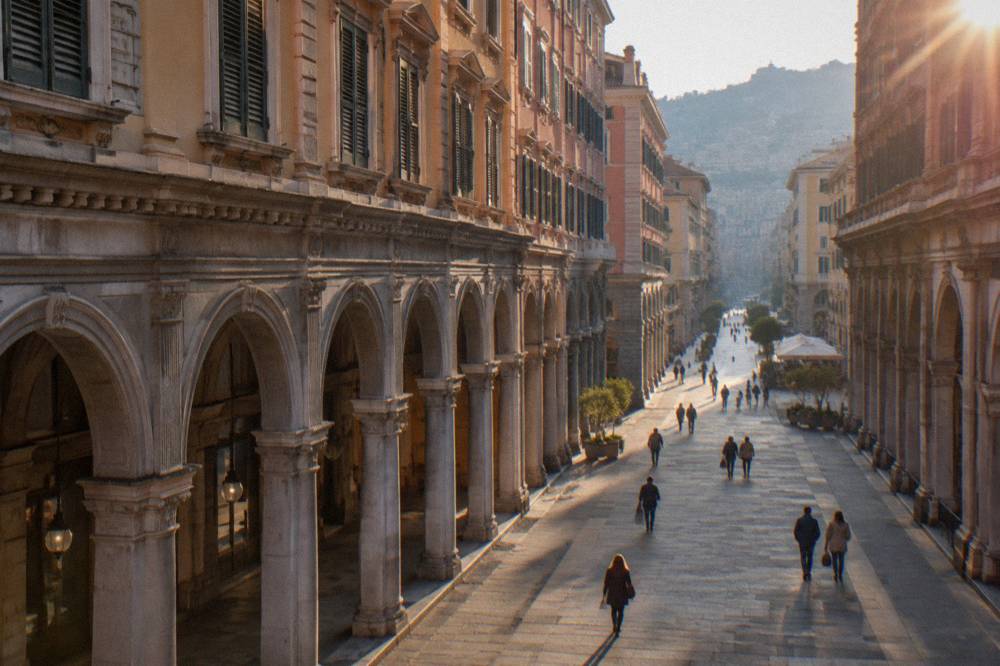
The dishes this site can name from its food facts are pesto genovese, focaccia, farinata, trofie and pansoti. Basilico Genovese PDO is the basil used for pesto genovese, per the basil consortium's own site, and focaccia di Recco has been IGP protected since 2015 and is produced only in Recco, Camogli, Sori and Avegno, reported from Ligurian sources. These are the traditions a Genoa market visit sits inside.
Pesto genovese is the city's signature sauce, and its protected basil is grown in Liguria under the Basilico Genovese PDO designation. The sauce is traditionally worked with a mortar, and pesto made this way is the subject of one of the cooking classes listed later on this page, where the technique is taught rather than just described. Trofie are the twisted pasta most often paired with pesto, and pansoti are the filled pasta served with a walnut sauce, both part of the same Genoese repertoire.
Focaccia is the everyday bread of the city, and focaccia di Recco is a distinct protected product: the IGP mark dates from 2015 and the production area is limited to four towns east of Genoa, Recco, Camogli, Sori and Avegno. Farinata is the chickpea pancake baked in a wood oven, another street food of the Ligurian coast.
| Dish or product | What it is | Protected status |
|---|---|---|
| Pesto genovese | Basil sauce, traditionally worked with a mortar | Uses Basilico Genovese PDO basil |
| Focaccia | Olive-oil flatbread of the Ligurian tradition | No designation stated in the facts |
| focaccia di Recco | Cheese-filled focaccia of the Recco tradition | IGP since 2015, made only in Recco, Camogli, Sori and Avegno |
| Farinata | Chickpea pancake baked in a hot oven | No designation stated in the facts |
| Trofie | Twisted pasta served with pesto | No designation stated in the facts |
| Pansoti | Filled pasta served with walnut sauce | No designation stated in the facts |
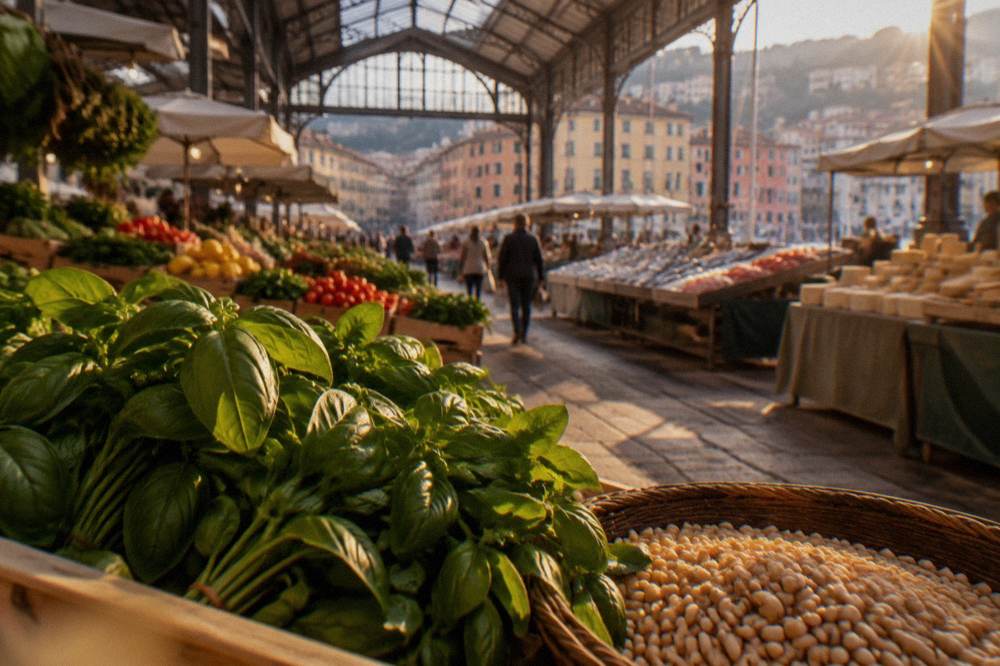
The market context matters because these dishes live or die on their ingredients. A covered market is the city's wholesale of fresh produce, and the basil, the vegetables and the fresh pasta of Genoese cooking all pass through counters like these. For visitors who want the traditions explained rather than just sampled, the site's featured tour for this page is the Genoa Food, Wine Tasting & History Walking Tour, which combines tastings with the city's history in one walk; Check availability on the operator's live listing. The tour's own page on this site describes what it covers.
To taste these ingredients with a guide alongside, book a traditional food and drinks tour here.
For a deeper dive, the site's food pages cover pesto genovese, focaccia and farinata individually, and the shopping guide extends the retail picture across the city. A cooking class is the other natural pairing: several of the classes in the roster below teach pesto with a mortar or fresh pasta by hand, which turns a market morning into a full food day.
What Sights Sit Within Reach Of The Market?
Piazza De Ferrari, the Cathedral of San Lorenzo, Palazzo Ducale and the UNESCO-listed Palazzi dei Rolli all sit in the central stretch of Genoa within the same walkable historic core, and Via XX Settembre leads directly to Piazza De Ferrari at its western end. The Genoa Museum Card costs 24 EUR for 24 hours or 45 EUR for 48 hours in the 2026 rates and covers 28 city museums, 19 municipal plus 9 others.
Via XX Settembre runs west into Piazza De Ferrari, the city's central square, from which the old town, the Cathedral of San Lorenzo and Palazzo Ducale are all reached on foot through the streets of the historic centre. West again lie the Palazzi dei Rolli, the 42 palaces of the UNESCO inscription "Genoa: Le Strade Nuove and the system of the Palazzi dei Rolli", inscribed in 2006, and the Musei di Strada Nuova that run through Palazzo Rosso, Palazzo Bianco and Palazzo Doria-Tursi.
The museum card is the economical way to see them. The 2026 rates are 24 EUR for 24 hours, 45 EUR for 48 hours, 60 EUR annual, 50 EUR for residents and 25 EUR for students, and the card covers 28 city museums. Only the "+bus" variants of the card include buses, and none of the variants covers Volabus, Navebus or trains, so the card and the AMT tickets are separate purchases unless you buy the combined version.
| Genoa Museum Card 2026 | Price | Coverage |
|---|---|---|
| 24-hour | 24 EUR | 28 city museums, 19 municipal plus 9 others |
| 48-hour | 45 EUR | Same 28 museums over 48 hours |
| Annual | 60 EUR | Same museums for a year |
| Residents | 50 EUR | Annual card for residents |
| Students | 25 EUR | Annual card for students |
The Strada Nuova museums keep a winter timetable from 28 September 2026 to 18 April 2027, open daily 10:00 to 18:30, but on Mondays only Palazzo Rosso can be visited, and the museums close on red weather alerts. The combined ticket for the Musei di Strada Nuova with the Museo di Sant'Agostino is 14 EUR full and 9 EUR reduced. Palazzo Doria-Tursi holds the violin "Il Cannone", built in Cremona in 1743 by Bartolomeo Giuseppe Guarneri and associated with Paganini.
Further out but still part of a market-day plan, the Aquarium of Genoa at the Porto Antico is open 365 days a year, with fixed-date adult tickets starting from 26.00 EUR, children 4 to 12 from 16.00 EUR and under-4s free, under dynamic pricing, per the Aquarium's own ticket page. A market morning and an Aquarium afternoon is a realistic family day, and the site's things to do in Genoa itineraries build on the same pairing.
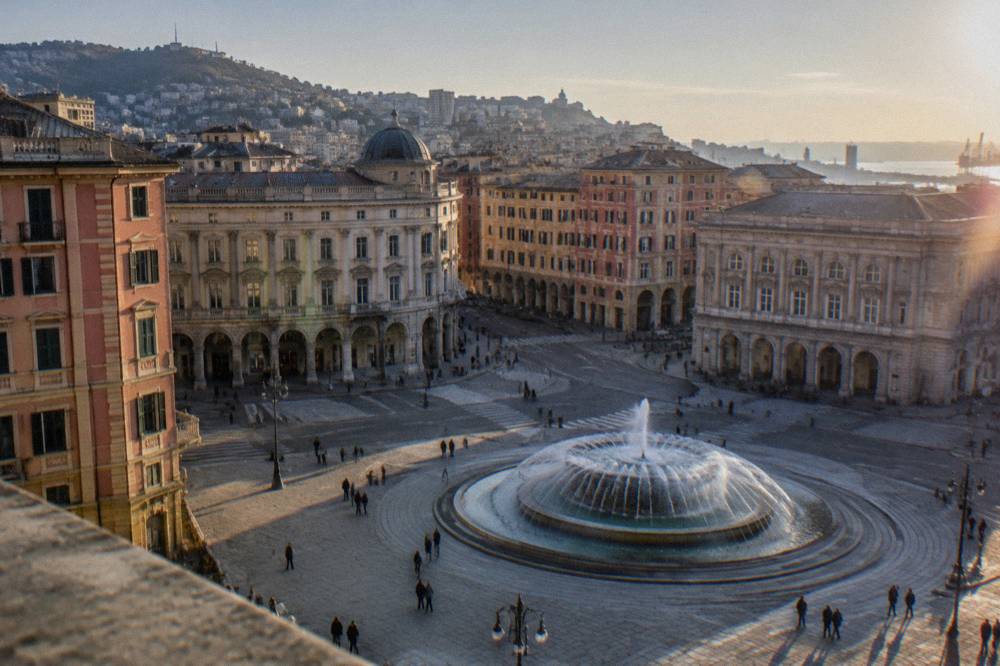
What Does The Area Around Via XX Settembre Offer Besides The Market?
Via XX Settembre is Genoa's principal shopping street, leading to Piazza De Ferrari and the Teatro Carlo Felice, with the historic centre, the exhibition halls of Palazzo Ducale and the caruggi of the old town all reached from its western end. The street is covered in its own page on this site, and the shopping guide lists the city's retail streets and districts from the same place list.
The street is the modern commercial axis against which the market's food shopping sits. Its own page on this site, Via XX Settembre, covers the street's role and its position between Piazza De Ferrari and the eastern districts of Foce and Albaro. The shopping guide extends the same coverage to the city's other retail addresses, from the boutiques of the centre to the shops of the Riviera towns.
East of the centre, the city's seaside addresses begin. Corso Italia is the seaside promenade about 4 km from Piazza De Ferrari in a straight line, leading to Boccadasse, the former fishermen's village also about 4 km straight-line. Nervi, with its parks and the Passeggiata Anita Garibaldi cliff walk, is about 9 km. All are reachable on the same 2.00 EUR AMT ticket within its 110 minutes, or with the Met Daily if you plan a full day of hopping. Other pages covering the same trip are gathered on Genoa Travel Guide.
| Place | Straight-line distance from Piazza De Ferrari |
|---|---|
| Corso Italia | About 4 km |
| Boccadasse | About 4 km |
| Nervi | About 9 km |
| Pegli | About 10 km |
| Genova Cristoforo Colombo Airport | About 7 km |
| Camogli | About 18 km |
| San Fruttuoso | About 22 km |
| Santa Margherita Ligure | About 24 km |
| Portofino | About 25 km |
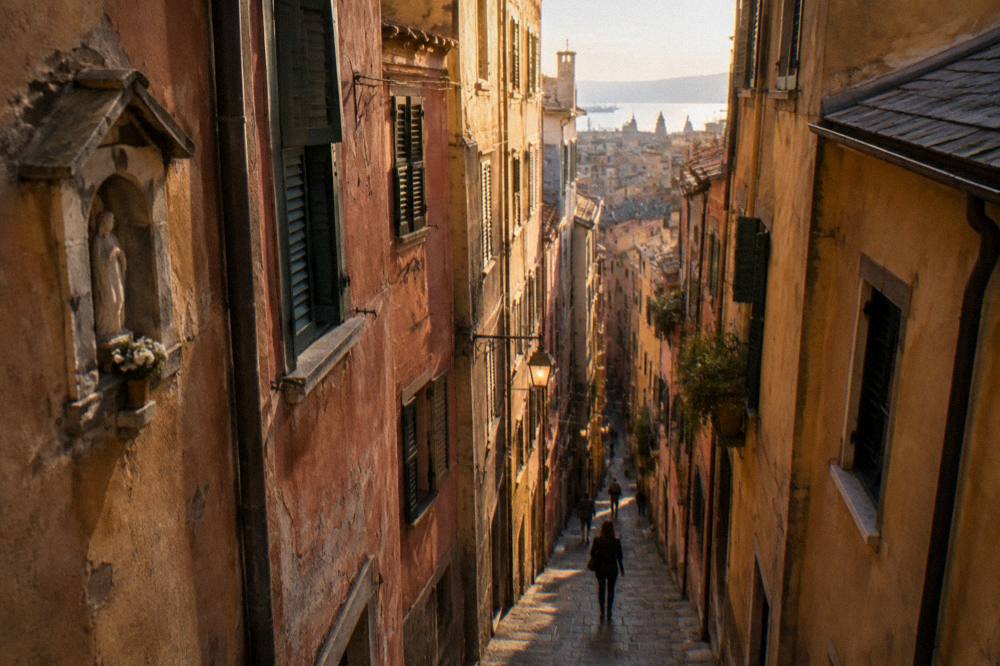
West of the market's street, the historic centre holds the caruggi, the narrow lanes of the medieval city, and sights such as the Columbus house, where Columbus lived between 1455 and 1470 according to the city's tourism site, and the Lanterna, the lighthouse rebuilt in 1543 whose tower stands 77 m on a 40 m rock, 117 m above the sea. The Zecca-Righi funicular and the Castelletto Levante lift both run daily 06:40 to 24:00, with a ride at 1.20 EUR, and give the rooftop views over the whole of this geography.
When Is The Best Time Of Year To Visit Genoa For A Market Trip?
The official 1971-2000 climate normals for Genoa Sestri show mean daily highs of 27.7 C in August against 11.5 C in January, with October recording 171.3 mm of rain and July 24.2 mm. Any month works for a covered market, but the rain figures matter for the rest of the day, and October brings the Festival della Scienza and the Rolli Days.
The climate table below is the full monthly picture from the Aeronautica Militare CLINO 1971-2000 normals for Genoa Sestri, the official station at the airport about 7 km west of Piazza De Ferrari. These are the only temperature and rainfall figures this site prints for the city.
| Month | Mean high C | Mean low C | Rain mm |
|---|---|---|---|
| Jan | 11.5 | 5.5 | 101.8 |
| Feb | 12.2 | 6.0 | 74.0 |
| Mar | 14.6 | 8.2 | 81.7 |
| Apr | 16.8 | 10.5 | 88.0 |
| May | 20.5 | 14.2 | 72.4 |
| Jun | 23.9 | 17.6 | 58.2 |
| Jul | 27.3 | 20.9 | 24.2 |
| Aug | 27.7 | 21.0 | 69.3 |
| Sep | 24.4 | 17.9 | 136.4 |
| Oct | 20.0 | 13.8 | 171.3 |
| Nov | 15.1 | 9.2 | 108.8 |
| Dec | 12.5 | 6.5 | 93.1 |
The autumn calendar is the busiest cultural stretch around a market visit. The Festival della Scienza ran 22 October to 1 November 2026 with about 250 events, and the autumn Rolli Days ran 16 to 18 October 2026, opening Rolli palaces with free entry and booking required, under the theme "Abitare il cambiamento", marking the twentieth anniversary of the UNESCO inscription. The Salone Nautico, the Genoa International Boat Show, ran 1 to 6 October 2026 in its 66th edition, and its 67th edition is set for 30 September to 5 October 2027.
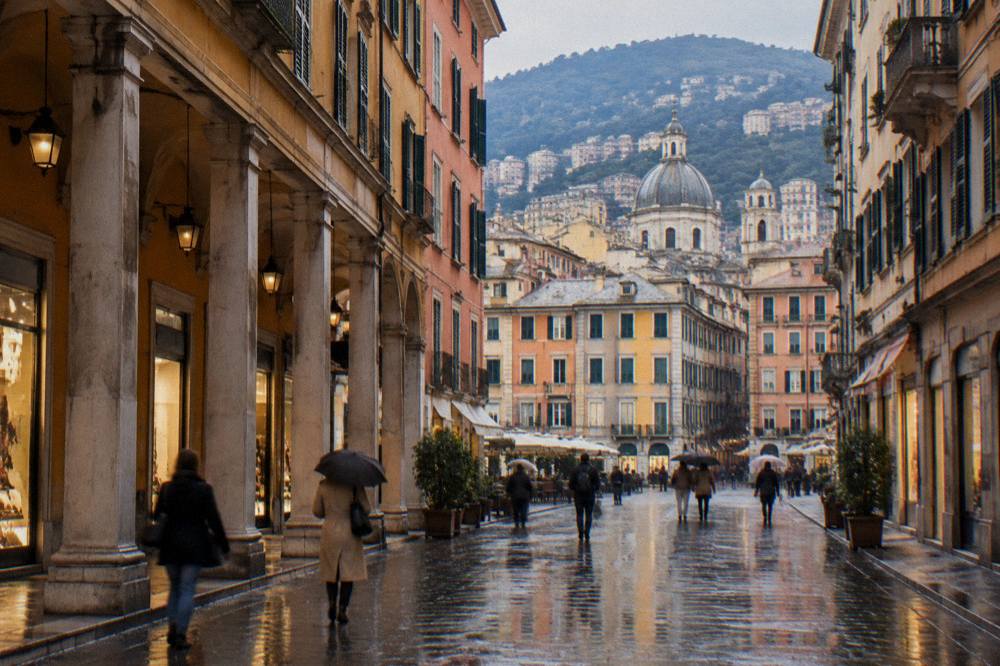
For a rainy day, which October's 171.3 mm monthly normal makes plausible, the site's Genoa in the rain itinerary collects the indoor options, and a covered market is naturally part of that list. In winter, the city's Christmas traditions are covered on the Christmas in Genoa page, though specific market dates for the season are not given there.
Should You Take A Guided Food Tour Of Genoa?
A guided food tour adds tastings, wine and a guide's context to what a market visit gives you on its own, and this site's roster includes a wine-tasting history walk, a full-meal small-group food tour and several cooking classes teaching pesto with a mortar and fresh pasta by hand. Prices, ratings and durations for each render on the tour cards and the operator's live listings, and free cancellation terms are stated at booking.
The choice is between exploring the market and the city's food counters independently, which costs only transport and whatever you buy, and adding a guided layer. The featured pairing for this page is the Genoa Food, Wine Tasting & History Walking Tour, whose card below shows what it covers, its from-price and its rating from the operator's listing data. The tour is part of the food-tour family on this site, and its own page carries the full description.
The cooking-class route suits visitors who want to leave with a skill. The rooftop class in the trio above teaches pesto and fresh pasta with wine, and the mortar pesto lesson card placed earlier on this page teaches the traditional technique with a tasting and local wine. All the classes in the band below have their own pages on this site, each describing what is cooked and what is included.
What Does A Genoa Trip Around The Market Cost?
A day built around the market and the centre costs 2.00 EUR in AMT transport per 110 minutes or 10.00 EUR for a 24-hour Met Daily covering the full network, 24 EUR for a 24-hour Genoa Museum Card covering 28 museums, and from 26.00 EUR for an Aquarium fixed-date adult ticket, with the tourist tax adding 2.00 to 5.00 EUR per person per night by accommodation category.
The tourist tax, the imposta di soggiorno set by the Comune di Genova, is charged per person per night for the first 8 consecutive nights. For hotels the 2026 tariffs are 3, 4 and 5 Under-14s are exempt.
| Cost item | 2026 figure |
|---|---|
| AMT single ticket | 2.00 EUR, 110 minutes |
| Met Daily 24h | 10.00 EUR, full network including Volabus |
| Genoa Museum Card 24h | 24 EUR, 28 museums |
| Genoa Museum Card 48h | 45 EUR, 28 museums |
| Aquarium fixed-date adult | From 26.00 EUR, dynamic pricing |
| Aquarium, Biosfera and Bigo combined adult | From 37.00 EUR |
| Tourist tax, 1-star hotel | 2.00 EUR per person per night |
| Tourist tax, 5-star hotel | 5.00 EUR per person per night |
| Tourist tax, B&B | 4.00 EUR per person per night |
| Airport taxi to centre | 25 EUR per car fixed, 30 EUR over 4 people |
Food costs are the one line this page cannot fill with figures: dish, coffee, meal and drink prices are not included here, and the advice is simply to check prices at the counter. The city's fixed costs, transport, museums and the tax, are modest, and a market-centred day leaves the budget for the food itself.
The emergency number in Italy is 112, worth knowing on any trip. The city's tourist information offices include IAT Garibaldi at Via Garibaldi 12r, open daily 09:00 to 18:20, and IAT Porto Antico at Ponte Spinola, daily 10:00 to 17:00, per the tourism office's own listing.
Common Questions About The Mercato Orientale In Genoa
What is the Mercato Orientale in Genoa?
It is the covered market on Via XX Settembre, Genoa's main shopping street, in the central stretch of the city. The market's name is settled; hours, stall lists and vendor details are not, so confirm locally what is open when you go.
How do I get to the Mercato Orientale?
Take any AMT service with a 2.00 EUR ticket valid 110 minutes. The metro stations De Ferrari and Brignole bracket Via XX Settembre at its western and eastern ends, and Genova Brignole rail and metro station sits at the eastern end of the street.
What food is Genoa famous for?
Pesto genovese made with Basilico Genovese PDO basil, focaccia, farinata, trofie and pansoti. Focaccia di Recco has been IGP protected since 2015 and is produced only in Recco, Camogli, Sori and Avegno.
Is the Mercato Orientale near Piazza De Ferrari?
Yes. Via XX Settembre runs west into Piazza De Ferrari, the city's central square, from which the Cathedral of San Lorenzo, Palazzo Ducale and the caruggi of the old town are reached on foot.
Does a bus ticket cover the metro in Genoa?
Yes. The 2.00 EUR ordinary AMT ticket is valid 110 minutes on the whole urban and metropolitan network, buses, metro and funiculars, with the stated exclusions. The Met Daily at 10.00 EUR covers 24 hours on the full network including Volabus.
Can I combine the market with a cooking class?
Yes, and it is a natural pairing. The cooking classes in the cards on this page teach pesto with a mortar and fresh pasta by hand, with tastings and wine, and each card links to its own page and live availability.
Genoa's covered market sits at the meeting point of the city's shopping street and its food traditions, and a visit there, reached on a 2.00 EUR ticket and paired with a food walk or a pesto class, is one of the most direct ways into the city's everyday life that a short trip allows.