What Is The Symbol Of Genoa?
The Lanterna lighthouse is the symbol of Genoa: its history, its figures, and how the city's other emblems, from the Cathedral of San Lorenzo to Paganini's violin, fit around it.
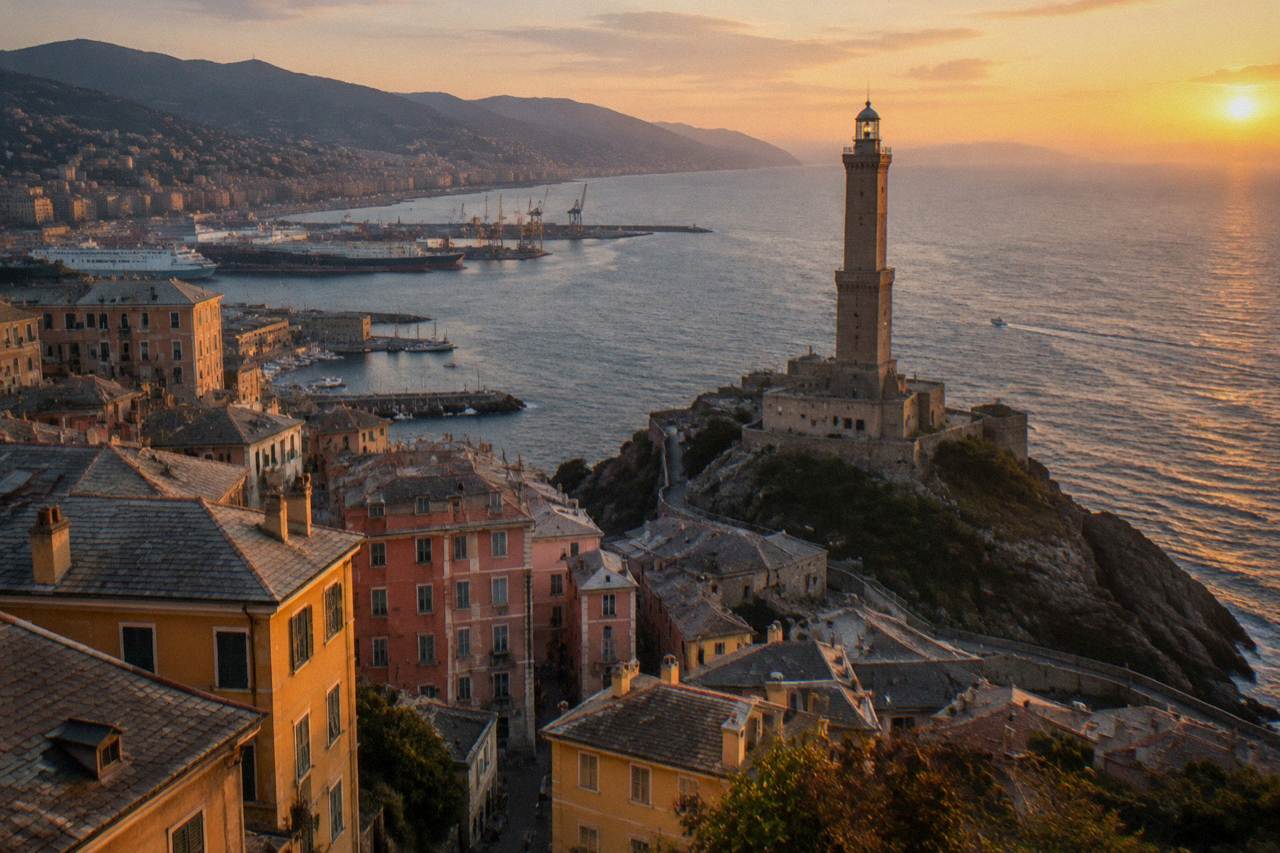
Genoa, the coastal city in Liguria on the Ligurian Sea, answers the question of its symbol with a single structure: the Lanterna, the lighthouse that has marked the entrance to the port for centuries. It is not a modern marketing choice. The tower is one of the oldest working elements of the city's identity, and its measurements are published: a 77 m tower standing on a 40 m rock, 117 m above the sea, with 172 steps climbing to the first terrace. Visit Genoa, the city's own tourism site, records the current tower as a reconstruction of 1543 on a site first built on in 1128, and bills it as the tallest lighthouse in the Mediterranean.
The question has more than one layer, though. A port city that ran an aristocratic republic until 1797 accumulates emblems the way a harbour accumulates rope, and the Lanterna shares the stage with the Cathedral of San Lorenzo, the caruggi of one of the largest medieval historic centres in Europe, and a violin that rarely leaves its palace. What the record actually supports begins with the lighthouse itself.
What Is The Symbol Of Genoa?
The symbol of Genoa is the Lanterna, the lighthouse at the western edge of the port, first built in 1128 and rebuilt in its current form in 1543. The tower rises 77 m from a 40 m rock, reaching 117 m above the sea, and carries 172 steps to its first terrace. Visit Genoa, the city's official tourism site, bills it as the tallest lighthouse in the Mediterranean.
Those figures come from the tourism authority's own page on the monument, which also gives the two dates that anchor the tower's history. The first structure on the promontory went up in 1128, when Genoa was already a maritime power expanding across the Mediterranean. The tower that stands today is the reconstruction of 1543, raised after the damage of the city's turbulent internal politics, and it has watched over the port through every era since: the decline of the Republic, the industrialisation of the harbour, and the modern cruise and ferry terminal that now moves 2.4 million cruise passengers and 2.6 million ferry passengers a year, according to the port authority's published numbers.
The lighthouse's role as symbol is structural as much as sentimental. Ships reaching Genoa from the sea have taken their bearing from this point since 1128, and the tower appears on everything from the port authority's materials to local club crests. The practical advice is to check the Lanterna's own site before planning a climb.
For readers deciding how the symbol fits into a wider visit, why Genoa is famous covers the ground beyond the harbour, and whether Genoa is worth visiting weighs the question for a first trip.
Why Is The Lanterna The Emblem Of A Merchant Republic?
The Lanterna became Genoa's emblem because it stood at the exact point where the city met the sea that made it rich, marking the entrance to the port that financed an aristocratic republic which lasted until 1797. The tower predates the Republic's fall by more than six centuries, first built in 1128, and its light governed the approach to a harbour that carried Genoese finance and shipping across the Mediterranean.
The Treccani encyclopaedia's entry on the Republic of Genoa traces that state from its late eleventh-century origins to its end under Napoleonic occupation in 1797, and the lighthouse spans nearly the whole arc. A city whose wealth came from the sea naturally fixed its identity on the structure that guarded the sea's gateway. The two dates on the tower, 1128 and 1543, sit on either side of Genoa's golden age, the period that produced the Strade Nuove and the Palazzi dei Rolli, inscribed by UNESCO in 2006 as "Genoa: Le Strade Nuove and the system of the Palazzi dei Rolli", a World Heritage property containing 42 palaces drawn from the Rolli lists of 1576, 1588, 1599, 1614 and 1664.
The contrast is worth sitting with. The palaces of the UNESCO inscription were the private instruments of banking families, houses rotated through public duty under the rollo system. The Lanterna belonged to no family. It was the one piece of the city's silhouette that served everyone who sailed into it, which is a fair working definition of a civic symbol.
| Lanterna figure | Value | Notes |
|---|---|---|
| First built | 1128 | Original structure on the promontory |
| Current tower | 1543 | Reconstruction that stands today |
| Tower height | 77 m | Stone tower above its base |
| Rock beneath | 40 m | Promontory height |
| Total above sea | 117 m | Tower plus rock |
| Steps to first terrace | 172 | Climbing route inside the tower |
| Billing | Tallest lighthouse in the Mediterranean | As billed by the city tourism site |
Is There More Than One Symbol Of Genoa?
Yes, Genoa carries several emblems alongside the Lanterna: the Cathedral of San Lorenzo, the caruggi of an old town covering 113 hectares, the Porto Antico redeveloped by Renzo Piano for the 1992 Columbus Expo, and Paganini's violin Il Cannone, built in Cremona in 1743, which the city's museum network displays at Palazzo Doria-Tursi. Each is documented on an official city or museum page.
The cathedral is the religious heart. Its Museo del Tesoro di San Lorenzo keeps the cathedral's treasury, opening Monday to Saturday from 09:00 to 12:00 and 15:00 to 18:00 and closing on Sundays, according to the tourism authority's listing. The old town around it is the physical core of the city's identity: 113 hectares of medieval fabric that Visit Genoa describes as one of the largest medieval historic centres in Europe, a maze of narrow caruggi that folds the cathedral, the Palazzo Ducale and the Musei di Strada Nuova into a single walkable district.
Il Cannone occupies its own niche in this gallery of emblems. The 1743 Guarneri violin associated with Niccolo Paganini is held at Palazzo Doria-Tursi, one of the three Strada Nuova museums, and the museums' own page records its maker and year. A city that displays a famous instrument in a Renaissance palace on a UNESCO-listed street is telling you something about how it reads itself.
Below the level of grand emblems sit the everyday ones: pesto genovese, made with Basilico Genovese PDO basil, and focaccia, the flat bread sold across the city. What Genoa's food fame amounts to is covered in detail at what food Genoa is famous for.
How Old Is The Lanterna Compared With Genoa's Other Landmarks?
The Lanterna's site dates from 1128, making it older than every major monument in the city's current skyline except the medieval fabric of the old town itself. The Cathedral of San Lorenzo and the caruggi grew up around the same medieval centuries, the Palazzi dei Rolli took their listed form from 1576, Il Cannone was built in 1743, and the Aquarium of Genoa opened as recently as 1992.
Lining the dates up shows how deep the lighthouse sits in the pile. The Rolli lists, the public registers from which visiting dignitaries were housed in private palaces, ran from 1576 to 1664, four centuries after the first lighthouse. UNESCO's inscription of the Strade Nuove system came in 2006, nearly nine hundred years after 1128. Even the Staglieno cemetery, another of the city's landmark spaces, opened to the public on 1 January 1851 with works begun in 1844, a relative newcomer beside the tower on the rock.
The Aquarium belongs to the modern layer. It opened in 1992 for the Columbus Expo, the same event that produced Renzo Piano's redevelopment of the Porto Antico and the Bigo lift beside it, and it now opens 365 days a year with adult fixed-date tickets starting from 26.00 EUR, per the Aquarium's own ticket page. The port it sits on, and the lighthouse on that port's other flank, form the frame around everything built since, and visitors should check the official site for current details before heading to the tower.
| Genoa landmark or emblem | Key date | What it marks |
|---|---|---|
| Lanterna site | 1128 | First lighthouse on the promontory |
| Lanterna tower | 1543 | Current reconstruction |
| Rolli lists | 1576, 1588, 1599, 1614, 1664 | Palace registers behind the UNESCO property |
| Il Cannone violin | 1743 | Built by Guarneri in Cremona, now at Palazzo Doria-Tursi |
| Republic of Genoa ends | 1797 | End of the aristocratic maritime state |
| Staglieno opens | 1851 | Cemetery opened 1 January, works from 1844 |
| Aquarium opens | 1992 | Opened for the Columbus Expo |
| UNESCO inscription | 2006 | Strade Nuove and the Palazzi dei Rolli |
Where Can You See The Symbol Of Genoa Today?
You can see the Lanterna from the harbour front and the sea approach, and you can visit the tower itself, whose opening days and prices are published on its own site. The symbol also runs through the city's institutions: the port authority's terminals at Ponte dei Mille and Andrea Doria handle the cruise traffic the lighthouse has watched over since its 1543 rebuild, and the tourism office at Ponte Spinola opens daily from 10:00 to 17:00.
The practical geography is straightforward. The lighthouse stands at the western mouth of the port, and the waterfront that connects it to the Porto Antico gives the clearest landward view. Out at sea, the tower remains the visual marker of the harbour entrance, the function it has performed since the original tower of 1128. Anyone planning a visit around the climb should check the Lanterna's own page for the current schedule, since openings are limited rather than daily and shift with the season.
The symbol also works as an organising idea for a short stay. How many days in Genoa is enough tackles the length question, and the Genoa Travel Guide's Genoa Travel Guide homepage pulls the city's sightseeing together for those who want the full picture rather than a single monument. Readers arriving by sea can start from walking into Genoa from the cruise port, which begins within sight of the tower itself.
A guided walk is one way to meet the city's symbols in context rather than chasing them one by one. The Check availability link beside this article covers an audio and written guide walk by a local, and the same principle applies to the food side of the city's identity, where the tastings and traditions around pesto and focaccia fill the story the lighthouse starts.
A self-guided route is another way to meet the symbols in context. Book a self-guided audio tour here.
Does The Symbol Of Genoa Appear On Flags And Crests?
The Lanterna appears on the crests of Genoese sporting and civic bodies, and the city's name and identity are bound up with its port imagery across official materials, but the emblem with the deepest documentary trail on this site is the built fabric itself: the 42 palaces of the UNESCO property, the 113-hectare old town and the lighthouse whose 1128 and 1543 dates are printed by the tourism authority.
That is a deliberately concrete answer. Heraldic detail about the city's arms is the kind of subject where second-hand guides improvise, and the disciplined position is to hold to what official pages state. What those pages do state is physical and verifiable: the World Heritage property inscribed in 2006 contains 42 palaces; the old town measures 113 hectares; the Lanterna rises 117 m above the sea. A city's symbol, in the end, is the sum of what it can point at.
There is a modern footnote to the story of what Genoa points at. The Ponte Morandi collapsed on 14 August 2018, and its replacement, the Ponte San Giorgio designed by Renzo Piano, was inaugurated on 3 August 2020. The episode is part of the city's recent self-understanding, covered at what happened to the Morandi bridge, and it underscores why the Lanterna's continuity matters to Genoa: a structure standing on its rock since 1543 is a rare fixed point in a changing port city.
Common Questions About The Symbol Of Genoa
What Is The Symbol Of Genoa?
The Lanterna lighthouse is the symbol of Genoa. First built in 1128 and rebuilt in 1543, the 77 m tower stands on a 40 m rock, reaching 117 m above the sea with 172 steps to its first terrace, and the city's tourism site bills it as the tallest lighthouse in the Mediterranean.
Can You Climb The Lanterna In Genoa?
The tower can be visited, and 172 steps lead to the first terrace. Check the Lanterna's own site for the current schedule before planning a visit.
Is The Lanterna Older Than The Palazzi Dei Rolli?
Yes. The lighthouse site dates from 1128 and the current tower from 1543, while the Rolli lists that produced the UNESCO-inscribed palaces ran from 1576 to 1664. UNESCO added the Strade Nuove system, containing 42 palaces, in 2006.
What Other Emblems Does Genoa Have Besides The Lanterna?
The Cathedral of San Lorenzo, the 113-hectare medieval old town, the Porto Antico redeveloped in 1992, and Paganini's 1743 violin Il Cannone at Palazzo Doria-Tursi all function as civic emblems, alongside the food symbols pesto genovese and focaccia.
Why Is A Lighthouse The Symbol Of A City?
Genoa's wealth came from the sea, and the Lanterna stood at the entrance to the port that financed a republic lasting until 1797. The tower served every ship entering the harbour, which made it a shared civic landmark rather than a monument to any one family.
The Lanterna answers the question, but it answers it best in context: a tower first raised in 1128, a Renaissance rebuild in 1543, a republic's harbour, and a modern cruise port, all visible from the same stretch of Ligurian shoreline.