What Famous Person Is From Genoa?
The famous people from Genoa, from Christopher Columbus to Niccolò Paganini and Renzo Piano, with the places in the city where their stories are still visible.
Genoa, the coastal city in Liguria on the Ligurian Sea, answers the famous-person question with a short list the sources actually support: Christopher Columbus, whose boyhood home stands off Piazza De Ferrari's old-town side; Niccolò Paganini, whose 1743 violin is kept in a city museum; and Renzo Piano, who reshaped the old harbour and later designed the bridge that replaced the collapsed Morandi viaduct. Each of these answers has a street address in the city, which is what makes the question worth more than a trivia reply. The Columbus house, the Palazzo Doria-Tursi and the Porto Antico are all within a compact city whose old town covers 113 hectares and is described by the city's own tourism site as one of the largest medieval historic centres in Europe.
What Famous Person Is From Genoa?
The name the city is asked about is Christopher Columbus: the Casa di Colombo is presented as the house where the family lived from 1455 and where the boy stayed until about 1470. Niccolò Paganini answers the same question through his violin, the 1743 Guarneri known as Il Cannone, kept at Palazzo Doria-Tursi, and Renzo Piano answers it through the 1992 Porto Antico redevelopment and the Ponte San Giorgio opened in 2020.
Those three names are the ones the destination's own pages attach to the city, and each comes with a verifiable object or date rather than a legend. The Casa di Colombo page on the city's tourism site states that the family moved into the house in 1455, when the boy was four, and that he lived there until about 1470. The museums' own pages record Il Cannone as a violin built in Cremona in 1743 by Bartolomeo Giuseppe Guarneri. Piano's work is dated twice over: the old harbour redevelopment for the 1992 Columbus Expo, and the Ponte San Giorgio inaugurated on 3 August 2020.
| Name | What The Record States | Where To See It In Genoa |
|---|---|---|
| Christopher Columbus | Family moved into the house in 1455, when he was four; he lived there until about 1470; the building is an 18th-century reconstruction on the original site | Casa di Colombo, old town |
| Niccolò Paganini | His violin Il Cannone was built in Cremona in 1743 by Bartolomeo Giuseppe Guarneri | Palazzo Doria-Tursi, Musei di Strada Nuova |
| Renzo Piano | Redeveloped the old harbour for the 1992 Columbus Expo; designed the Ponte San Giorgio, inaugurated 3 August 2020 | Porto Antico with the Bigo; the bridge above the Polcevera valley |
A fourth entry belongs on the list even though it is a family rather than a person. The Republic of Genoa lasted until 1797, and the aristocratic families who ran it built the palaces that UNESCO inscribed in 2006 as "Genoa: Le Strade Nuove and the system of the Palazzi dei Rolli", a property of 42 palaces drawn from lists compiled in 1576, 1588, 1599, 1614 and 1664. For a wider frame on what the city is known for, see why Genoa is famous.
Where Does The Christopher Columbus Story Stand In Genoa?
The Casa di Colombo is the anchor: the city's tourism site presents it as the house where the family lived from 1455, with the boy resident until about 1470, and notes that the building standing today is an 18th-century reconstruction on the original site. That is the full extent of what the destination's own page claims, dates included, and it is more concrete than the general label the name usually carries.
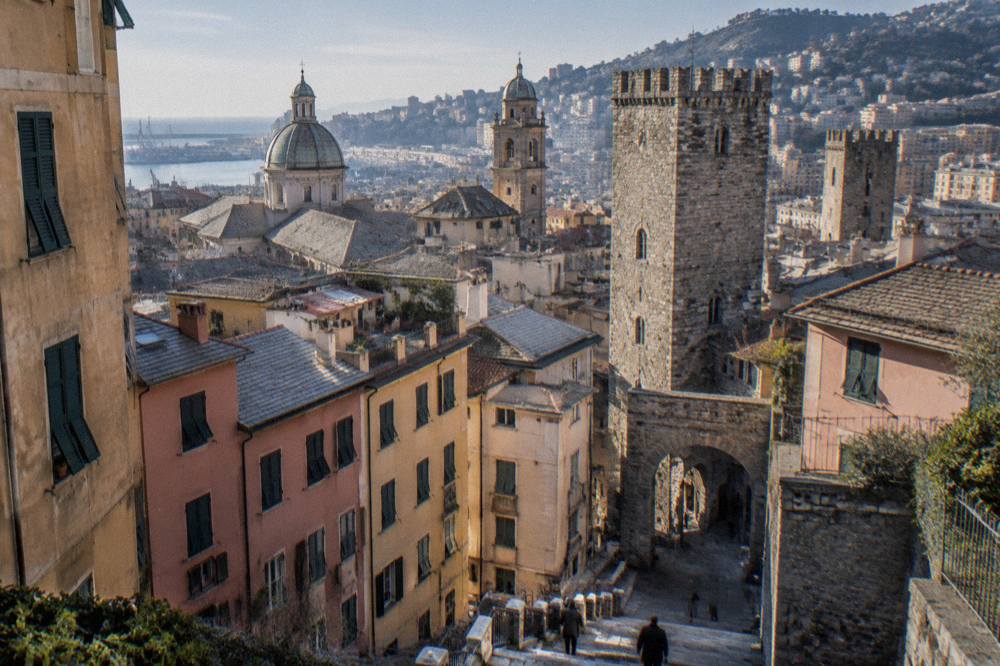
The house sits in the old town, the 113-hectare medieval core described by the tourism site as one of the largest historic centres of its kind in Europe. Its page on visitgenoa.it groups the house with the cloister of Sant'Andrea and the towers of Porta Soprana, so the visit is a cluster rather than a single facade. The dates matter more than the plaque: 1455 is when the family moved in, and roughly 1470 is when the boy left, which is all the biography the page supplies. Anything further about the man belongs to ocean-crossing history rather than to this street corner.
The city keeps the connection alive institutionally as well. The Aquarium of Genoa opened in 1992 for the Expo that bore the Columbus name, and the entire Porto Antico redevelopment by Piano was carried out for that same event. So the explorer's name is stamped on the year modern Genoa rebuilt its waterfront. If the question behind your search is whether the city rewards a day of wandering, how many days in Genoa is enough breaks down the trade-offs, and whether Genoa is worth visiting covers the broader case.
What Can You See Of Niccolò Paganini In Genoa?
Paganini's trace in Genoa is a single, specific object: the violin called Il Cannone, built in Cremona in 1743 by Bartolomeo Giuseppe Guarneri, displayed at Palazzo Doria-Tursi in the Musei di Strada Nuova. The museums' own page for the Paganini rooms is the source for both the instrument and its maker, and the palace is one of three that a single combined ticket covers under the current winter timetable.
Palazzo Doria-Tursi sits on the Strade Nuove, the street the UNESCO inscription of 2006 covers together with the Palazzi dei Rolli system. The combined ticket for the Musei di Strada Nuova plus the Museo di Sant'Agostino costs 14 EUR full price and 9 EUR reduced, and in the winter timetable running 28 September 2026 to 18 April 2027 the museums open daily from 10:00 to 18:30, with one caveat: on Mondays only Palazzo Rosso can be visited. The same museums hold the Strada Nuova collections that explain why the street, not just the violin, draws people up from the old town.
| Paganini-Related Visit | Verified Detail |
|---|---|
| Il Cannone | Violin built in Cremona in 1743 by Bartolomeo Giuseppe Guarneri, at Palazzo Doria-Tursi |
| Musei di Strada Nuova combined ticket | 14 EUR full, 9 EUR reduced, covering the three palaces plus the Museo di Sant'Agostino |
| Winter timetable, 28 September 2026 to 18 April 2027 | Daily 10:00 to 18:30; Monday visits limited to Palazzo Rosso |
| Genoa Museum Card | 24 EUR for 24 hours or 45 EUR for 48 hours, covering 28 city museums |
A private guide is one way to connect the violin, the palaces and the Columbus house in a single loop, since the distances between them are short but the streets between them are the caruggi, where signage is sparse. The Check availability link beside the private custom walking tour shows the operator's live listing for exactly that kind of shaped route.
How Did Renzo Piano Reshape The Genoa Waterfront?
Renzo Piano's Genoa is the Porto Antico redevelopment carried out for the 1992 Columbus Expo, including the Bigo lift and the setting of the Aquarium that opened the same year, and, decades later, the Ponte San Giorgio inaugurated 3 August 2020 to replace the Ponte Morandi that collapsed on 14 August 2018. The bridge is 1,067 metres long on 18 piers, at a reported cost of about 202 million EUR.
The 1992 project is why the old harbour reads as a modern public space at all: the Aquarium, the Biosfera, the Bigo and the promenade around them date to that redevelopment. The Aquarium's own pages state it opened in 1992, is open 365 days a year, and sells fixed-date adult tickets from 26.00 EUR with children aged 4 to 12 from 16.00 EUR, while the combined Aquarium, Biosfera and Bigo ticket starts from 37.00 EUR for an adult. The Bigo lift alone is listed at 6.00 EUR adult on the Aquarium's site.
The 2020 bridge belongs to a harder chapter. The Morandi viaduct collapsed on 14 August 2018, and the replacement was inaugurated on 3 August 2020. Piano's connection to the city therefore spans the two events Genoa is least able to forget and the one it showcases: the harbour that anchors visits today, and the crossing that restored the A10 motorway route. For the coastal shape of the city that frames all of this, what the symbol of Genoa is covers the Lanterna, the lighthouse first built in 1128 and rebuilt in 1543, standing 117 metres above the sea and billed as the tallest lighthouse in the Mediterranean.
How Do You Build A Day Around Genoa's Famous Names?
A single day can cover all three names on foot and by lift: the Casa di Colombo in the old town, Il Cannone at Palazzo Doria-Tursi on the Strade Nuove, and the Piano-designed Porto Antico down at the water, with the Zecca-Righi funicular or the Castelletto Levante lift, both running daily 06:40 to 24:00, as the vertical links between them.
An AMT ticket costs 2.00 EUR and is valid 110 minutes on the whole network, and a lift or funicular ride costs 1.20 EUR.
The route runs downhill in altitude and uphill in chronology. Start high at the Spianata Castelletto for the roofline view, drop into the caruggi for the Columbus house, continue to Via Garibaldi for the palaces and the violin, and finish at the Porto Antico where the 1992 redevelopment meets the sea. The whole chain sits inside a city of 566,247 residents at 1 January 2026, reported by ISTAT, so this is a working port city rather than a museum town, and the famous names share the streets with the ferry terminals that moved 2.6 million ferry passengers according to the port's own figures.
Want to follow that route through the caruggi and the Strade Nuove? Book a self-guided audio tour here.
Why Does The Famous-Person Question Keep Expanding In Genoa?
Every answer to the famous-person question opens onto a bigger subject: Columbus leads to the 1992 Expo and the Aquarium, Paganini leads to the UNESCO inscription of 2006 and the 42 Palazzi dei Rolli drawn from lists of 1576, 1588, 1599, 1614 and 1664, and Piano leads from the old harbour to the bridge of 2020. The Republic that produced all of this lasted until 1797, and the old town it left behind covers 113 hectares.
That is the honest shape of the answer. Genoa's famous individuals are inseparable from the institutions they built or that commemorated them. The Rolli palaces were a state hospitality system, the museums that hold Il Cannone are themselves part of the UNESCO property, and the Piano waterfront exists because of the Columbus quincentennial. Even the city's modern calendar carries the echo: the autumn 2026 Rolli Days ran 16 to 18 October marking twenty years since the UNESCO inscription, and the Festival della Scienza ran 22 October to 1 November 2026 under the theme "Prospettive". The next Salone Nautico, the boat show that fills the port, is fixed for 30 September to 5 October 2027.
For readers deciding how the city compares with its neighbours as a base, whether to go to Genoa or Portofino weighs the trade-offs, and the root things to do in Genoa page lists the full sight inventory. This site, Genoa Travel Guide, covers each of the places named above in its own guide.
Common Questions About Famous People From Genoa
What Famous Person Is From Genoa?
Christopher Columbus is the name the city is asked about: the Casa di Colombo is presented as the house where the family lived from 1455 and where the boy stayed until about 1470. Niccolò Paganini, whose 1743 violin Il Cannone is at Palazzo Doria-Tursi, and Renzo Piano, who redeveloped the Porto Antico in 1992 and designed the Ponte San Giorgio opened in 2020, complete the list the sources support.
Was Christopher Columbus Really Born In Genoa?
The city's own tourism page states that the family moved into the Casa di Colombo in 1455, when the boy was four, and that he lived there until about 1470. It also states that the building standing today is an 18th-century reconstruction on the original site. The page makes no claim beyond those dates and that reconstruction.
Where Is Paganini's Violin In Genoa?
Il Cannone is displayed at Palazzo Doria-Tursi, one of the three Musei di Strada Nuova. The museums' pages record it as a violin built in Cremona in 1743 by Bartolomeo Giuseppe Guarneri. The combined ticket for the Strada Nuova museums plus the Museo di Sant'Agostino costs 14 EUR full price, 9 EUR reduced.
Is The Christopher Columbus House Open?
The house is an 18th-century reconstruction on the original site, grouped by the city's tourism site with the cloister of Sant'Andrea and the towers of Porta Soprana. Check the venue's own page for current opening details before you go.
What Did Renzo Piano Build In Genoa?
Two things the record dates precisely: the Porto Antico redevelopment for the 1992 Columbus Expo, which includes the Bigo, and the Ponte San Giorgio inaugurated 3 August 2020, a 1,067-metre bridge on 18 piers that replaced the Ponte Morandi after its collapse on 14 August 2018.
How Is The Aquarium Connected To Columbus?
The Aquarium of Genoa opened in 1992 for the Expo that carried the Columbus name, and the whole Piano redevelopment of the old harbour was carried out for the same event. The Aquarium is open 365 days a year, with fixed-date adult tickets from 26.00 EUR on dynamic pricing.