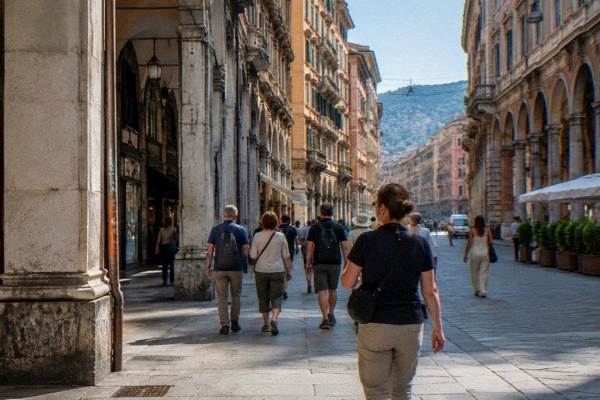
Does It Rain A Lot In Genoa?
Genoa gets well over a metre of rain a year, with October the wettest month at 171.3 mm and July at 24.2 mm. Here is what the official climate normals say and what rain means for a visit.
Genoa, the coastal city in Liguria on the Ligurian Sea, sits where the Apennine hills meet the Mediterranean, and that position shapes its rain. The official Aeronautica Militare CLINO 1971-2000 normals for the Genoa Sestri station, at the airport about 7 km west of Piazza De Ferrari, record a yearly total of just over a metre of rain. Whether that counts as "a lot" depends on the month: July averages just 24.2 mm, while October averages 171.3 mm, more than seven times as much. The honest answer is that Genoa has a dry summer and a genuinely wet autumn, and the rest of the year sits in between. This page sets out the full monthly figures, explains why the pattern looks the way it does, and covers what rain means in practice for a visit, with the Genoa Travel Guide approach of reporting what the official normals actually say.
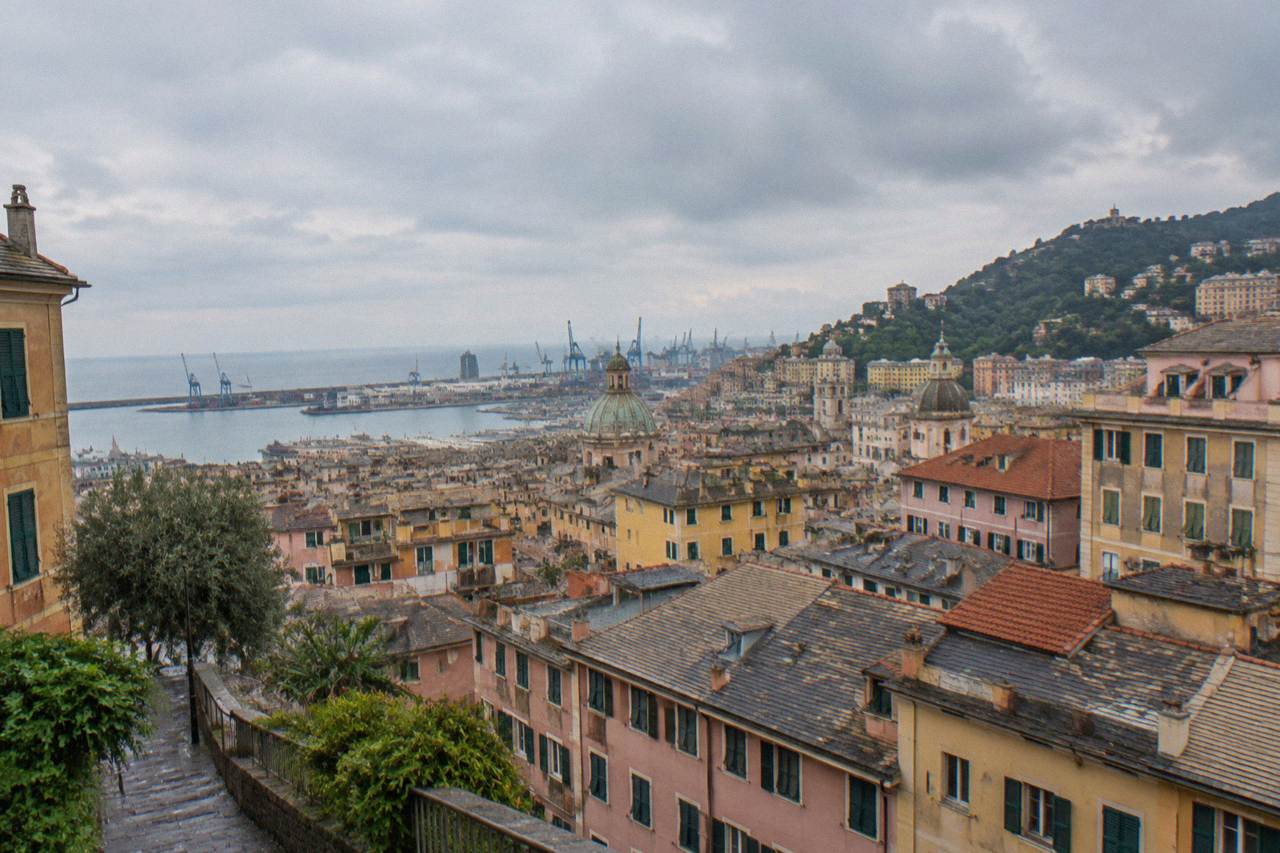
Does It Rain A Lot In Genoa?
Compared with the drier parts of the Mediterranean coast, yes, Genoa takes a meaningful amount of rain, well over a metre a year in the official 1971-2000 normals for Genoa Sestri, but it is not spread evenly: July averages only 24.2 mm with 2.8 rain days, while October averages 171.3 mm, and the four months from September to December each carry more than the yearly monthly average of roughly 90 mm. So the honest answer is seasonal rather than a flat yes or no.
The city's position explains the split. Genoa lies on a narrow coastal strip at the foot of the Apennines, and when moist south-westerly air is forced up over those hills the rain concentrates on the coastal side. The same geography that gives Liguria its steep, terraced coastline also concentrates autumn rainfall over the Genoa area, which is why the totals climb sharply from September onward and why the late-October figures matter for trip planning.
It also helps to know what a "rain day" means in these normals. The figure of 2.8 rain days for July indicates how the station counts days with measurable precipitation, and the contrast between that and the autumn months is the clearest signal in the whole table. A summer week in Genoa can pass without rain, while an October week without any at all would run against the averages.
For the full picture, including temperatures month by month, see the site's Genoa weather and climate guide.
How Much Rain Does Genoa Get Each Month?
The official Aeronautica Militare CLINO 1971-2000 normals for Genoa Sestri give January 101.8 mm, February 74.0 mm, March 81.7 mm, April 88.0 mm, May 72.4 mm, June 58.2 mm, July 24.2 mm, August 69.3 mm, September 136.4 mm, October 171.3 mm, November 108.8 mm and December 93.1 mm, a yearly total of just over a metre. October carries the highest monthly total, July the lowest.
The table below reproduces those normals alongside the mean daily high and low temperatures from the same station record, so the rain figures can be read against the season they belong to.
| Month | Mean high C | Mean low C | Rain mm |
|---|---|---|---|
| Jan | 11.5 | 5.5 | 101.8 |
| Feb | 12.2 | 6.0 | 74.0 |
| Mar | 14.6 | 8.2 | 81.7 |
| Apr | 16.8 | 10.5 | 88.0 |
| May | 20.5 | 14.2 | 72.4 |
| Jun | 23.9 | 17.6 | 58.2 |
| Jul | 27.3 | 20.9 | 24.2 |
| Aug | 27.7 | 21.0 | 69.3 |
| Sep | 24.4 | 17.9 | 136.4 |
| Oct | 20.0 | 13.8 | 171.3 |
| Nov | 15.1 | 9.2 | 108.8 |
| Dec | 12.5 | 6.5 | 93.1 |
Read as seasons, the pattern is simple. Winter and spring each hover between about 72 and 102 mm a month, steady rather than dramatic. Summer drops away, from 58.2 mm in June to 24.2 mm in July before climbing back to 69.3 mm in August. Then autumn arrives: September jumps to 136.4 mm, October peaks at 171.3 mm, and November still carries 108.8 mm. Anyone comparing Genoa with, say, the far south of Italy should note that these are the official station normals, not an impression, and the yearly total, more than a metre of rain, is the figure to quote.
Temperatures stay mild throughout, which matters for how rain feels. The mean daily high never falls below 11.5 C and the mean daily low never below 5.5 C, so even a wet January day in Genoa is rarely a cold one by northern European standards.
When Is The Wettest Time Of Year In Genoa?
October averages 171.3 mm in the official 1971-2000 normals for Genoa Sestri, followed by September at 136.4 mm and November at 108.8 mm, so the core of the rainy season is autumn. July records 24.2 mm with 2.8 rain days, and June records 58.2 mm.
Autumn rainfall on this coast can arrive in intense bursts rather than steady drizzle, a well-known feature of the Ligurian Sea basin when warm, moist air meets the Apennine slopes. The normals record monthly totals, not the shape of individual storms, so a month like October can combine long dry stretches with a small number of very heavy falls.
One practical detail worth knowing: the city's own systems respond to severe weather alerts. The Musei di Strada Nuova, the trio of Palazzo Rosso, Palazzo Bianco and Palazzo Doria-Tursi on Via Garibaldi, close on RED weather alerts, and the comune has issued notices closing Staglieno, the monumental cemetery, on weather alerts too. On the rare days when an alert is active, indoor plans can shift as well, so it is worth checking the venue's own channels on a stormy morning.
For travellers weighing autumn against other seasons, the same months that carry the rain also carry two of the city's headline events: the Salone Nautico boat show ran 1 to 6 October in 2026, the 66th edition, and the Rolli Days opened the UNESCO-listed palaces 16 to 18 October 2026. Rain statistics and event calendars point in different directions in October, and each traveller weighs them differently.
Does Rain Ruin A Trip To Genoa?
Rain does not close Genoa down, because a large share of its sights are indoor or partly covered: the Aquarium of Genoa is open 365 days a year, the Strada Nuova museums keep daily hours of 10:00 to 18:30 in the winter timetable running 28 September 2026 to 18 April 2027, the caruggi lanes of the old town are narrow and partly sheltered, and the Genoa Museum Card covers 28 city museums for 24 EUR over 24 hours or 45 EUR over 48 hours.
The single most useful object on a rainy day is the Genoa Museum Card. The 2026 rates are 24 EUR for 24 hours and 45 EUR for 48 hours, and the card covers 28 city museums, 19 municipal plus 9 others. Only the "+bus" variants of the card include buses, and no variant covers Volabus, the Navebus boat or trains, so plan foot-based museum hops unless the bus variant is what you hold.
The Aquarium of Genoa is the anchor indoor sight. It opened in 1992 and is open every day of the year, with fixed-date adult tickets starting from 26.00 EUR, reduced tickets from 20.00 EUR, children aged 4 to 12 from 16.00 EUR and under-4s free, all under dynamic pricing, according to the Aquarium's own ticket page. The combined Aquarium, Biosfera and Bigo ticket starts from 37.00 EUR for an adult, which bundles the panoramic lift at the Porto Antico into a wet-weather itinerary.
Getting between sights in rain is cheap. An AMT ordinary ticket costs 2.00 EUR and is valid 110 minutes on the whole urban network, including the metro from Brin to Brignole with its 8 stations, among them De Ferrari and Principe. The lifts and the Sant'Anna funicular cost 1.20 EUR a ride, and the Castelletto Levante lift and the Zecca-Righi funicular run daily from 06:40 to 24:00, though a viewpoint visit is better saved for a clear day.
For a full wet-day plan worked through sight by sight, see what to do in Genoa in the rain.
What To Do In Genoa When It Rains?
The strongest rainy-day options are the Aquarium of Genoa at the Porto Antico, the three Strada Nuova museums on Via Garibaldi, Palazzo Ducale's exhibition programme, and a guided walk or food tour through the old town's caruggi, where the narrow lanes and arcades blunt the weather; the Strada Nuova museums' combined ticket with the Museo di Sant'Agostino costs 14 EUR full or 9 EUR reduced, and in the winter timetable they open daily 10:00 to 18:30, with Mondays limited to Palazzo Rosso only.
The old town is the reason a wet day in Genoa is more workable than in many coastal resort towns. The caruggi, the narrow medieval lanes of a historic centre the official tourism site describes as one of the largest medieval historic centres in Europe at 113 hectares, are tight enough that shelter is rarely far. A guided walk that threads the lanes with street food stops keeps moving between overhangs, doorways and counters. The Genoa walking tour of hidden treasures and street food covers exactly that ground, and Check availability if the forecast for your dates looks mixed.
Palazzo Ducale carries a rolling exhibition programme: World Press Photo 2026 ran to 8 December 2026, and a show of Renoir, Monet, Toulouse-Lautrec and Cézanne opened 15 October 2026. Exhibition hours vary by day of the week, so the venue's own pages are the place to confirm timing before setting out in the rain.
Food is the other wet-weather pillar. Pesto genovese, made with Basilico Genovese PDO basil, trofie pasta, focaccia and farinata are the city's staples, and a tasting walk turns a grey afternoon into an itinerary with a roof over most of it. The question of what food Genoa is famous for has a longer answer than most cities can offer.
How Should You Pack For Genoa Weather?
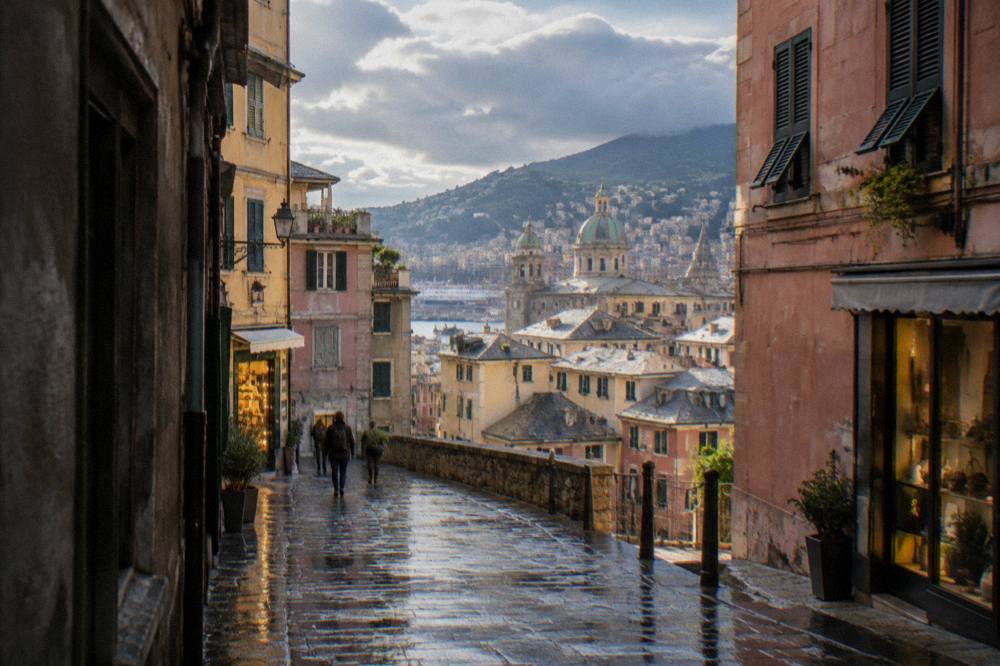
Pack for mild temperatures and possible concentrated rain: with mean highs between 11.5 C in January and 27.7 C in August, and mean lows between 5.5 C and 21.0 C in the official Genoa Sestri normals, layers carry the year, a waterproof layer earns its place outside the June and July window, and sturdy shoes matter because the city climbs steeply from the sea into the hills, with lifts and funiculars, at 1.20 EUR a ride, doing some of the climbing.
The month-by-month picture below pairs the rain figures with what they suggest for a suitcase. It is a planning guide built from the normals, not a forecast.
| Period | Rain in normals | Packing emphasis |
|---|---|---|
| Dec to Feb | 93.1, 101.8, 74.0 mm | Warm layers, waterproof jacket, days stay mild for winter |
| Mar to May | 81.7, 88.0, 72.4 mm | Layers, foldable umbrella, mixed sun and showers |
| Jun to Jul | 58.2, 24.2 mm | Light clothing, sun protection, rain cover rarely needed |
| Aug | 69.3 mm | Light clothing plus a jacket for possible heavy falls |
| Sep to Nov | 136.4, 171.3, 108.8 mm | Solid waterproofs, spare shoes, flexible indoor plans |
Footwear deserves a specific word. Genoa's streets rise from the waterfront into the hill districts, and the historic lanes are cobbled and polished. Wet stone underfoot is the one genuinely unpleasant version of Genoa rain, and shoes with grip matter more here than in a flatter city. The public lifts help: AMT runs 14 of them, and the Castelletto Levante lift rises 57 m from Piazza Portello to the Spianata Castelletto viewpoint, running daily 06:40 to 24:00.
Common Questions About Rain In Genoa
Does It Rain A Lot In Genoa?
Compared with many Mediterranean destinations, Genoa takes a substantial yearly total, more than a metre of rain in the official 1971-2000 normals for Genoa Sestri, but the distribution matters more than the total: July averages 24.2 mm while October averages 171.3 mm. Summer is dry, autumn is wet, and the rest of the year sits between roughly 72 and 102 mm a month.
What is the wettest month in Genoa?
October, with 171.3 mm of rain in the official 1971-2000 normals for Genoa Sestri. September is next at 136.4 mm, then November at 108.8 mm, so the whole autumn block carries the heaviest rainfall of the year.
What is the driest month in Genoa?
July, with 24.2 mm of rain and 2.8 rain days in the official normals, followed by June at 58.2 mm. The June and July figures together mark the dry core of the Genoa summer.
Does it rain all day in Genoa when it rains?
The station normals record monthly totals, not the length of individual rain events, so no figure answers this directly. Autumn rainfall on the Ligurian coast can arrive in heavy concentrated falls, which is why the site recommends keeping flexible indoor options, from the Aquarium to the Strada Nuova museums, rather than assuming steady drizzle.
Is Genoa still worth visiting in the rainy months?
Yes. The Aquarium of Genoa is open 365 days a year, the Genoa Museum Card covers 28 city museums for 24 EUR over 24 hours, the Strada Nuova museums keep daily winter hours of 10:00 to 18:30 with Monday visits limited to Palazzo Rosso, and the caruggi lanes offer partly sheltered walking. The question is Genoa worth visiting has a fuller answer elsewhere on the site.
Do attractions in Genoa close for rain?
Ordinary rain does not close them, but severe weather alerts can: the Musei di Strada Nuova close on RED weather alerts, and Staglieno, the monumental cemetery, has been closed by comune notices during weather alerts. On a stormy morning, checking a venue's own channels before leaving is the reliable move.