Can I Use Uber In Genoa?
Getting around Genoa without ride-hailing: fixed airport taxi fares, the 2.00 EUR AMT ticket, the Met Daily pass and what the metro actually covers.
Genoa is a coastal city in Liguria, north-west Italy, squeezed between the Ligurian Sea and the Apennine hills, and that shape decides how you move through it. The centre is dense, the old town is a web of caruggi, and the practical question behind "Can I Use Uber In Genoa?" is really whether you need an app at all. The short version: the transport picture that AMT Genova and the airport publish is built around taxis, buses, the metro and the funiculars, and none of it depends on a phone booking a stranger's car.
Can I Use Uber In Genoa?
The dependable ways around Genoa are licensed taxis and the AMT public network, not a ride-hailing app. The airport's own ground-transport page lists taxis at a fixed 25 EUR per car into the centre, and an AMT ordinary ticket costs 2.00 EUR and stays valid for 110 minutes across the whole Città Metropolitana network. Between those two and the metro, every journey a visitor normally makes in Genoa is covered without a booking app.
Neither the airport's page nor the AMT network, the two bodies that define official transport in the city, treats app-based ride-hailing as part of the offer. What they publish instead is a complete, cheap and legible system. The fixed taxi fares from Genova Cristoforo Colombo airport are set out in EUR per car, so there is no meter anxiety on arrival. The AMT side covers buses, the metro, the public lifts and the Zecca-Righi funicular, with tickets you buy at machines, retailers, through the AMT app or by contactless card on board.
The consequence for planning is simple. You do not build a Genoa itinerary around waiting for a car to appear on a map. You build it around a 2.00 EUR ticket that carries you across town for 110 minutes, a 10.00 EUR day pass when you want the airport bus included, and taxis at ranks or the airport for the moments when the hills defeat you. The rest of this page sets out exactly what each of those costs and covers, with figures from the operator's own fare tables.
How Do Taxis Work In Genoa?
Taxis in Genoa work on fixed published fares from the airport and metered or agreed fares in the city, with the airport rate set at 25 EUR per car for up to four people. The airport's own page sets out the numbers: 30 EUR for over four people, a 2 EUR supplement at night and on holidays, and shared-ride rates of 8 EUR per person to Brignole or 7 EUR per person to Principe with a three-person minimum.
Those airport figures are the ones worth memorising, because they remove the classic arrival worry of a driver taking the scenic route. Per-person shared fares drop to 6 EUR for Principe once four people ride, which can undercut the bus for a family with luggage. In the city itself, taxis operate from ranks, and the fixed-fare structure only applies to the airport corridor described on the airport page.
| Route | Fare | Notes |
|---|---|---|
| Airport to city centre, per car | 25 EUR | Up to 4 people |
| Airport to city centre, per car | 30 EUR | Over 4 people |
| Night and holiday supplement | 2 EUR | Added to the fixed fare |
| Airport to Brignole, per person | 8 EUR | Minimum 3 people |
| Airport to Principe, per person | 7 EUR | Minimum 3 people |
| Airport to Principe, per person | 6 EUR | Minimum 4 people |
One more airport fact belongs here: the Volabus connects the airport with Genova Piazza Principe, De Ferrari and Genova Brignole in about 30 minutes, and it requires the 10.00 EUR Met Daily ticket, valid for 24 hours on the full network. The bus requires the Met Daily 24-hour ticket at 10.00 EUR, which then covers the entire AMT network for the day, including line 782 toward Portofino. For a solo traveller that is less than half the taxi's fixed rate, and it leaves you with a day pass in hand. The trade-off questions are covered in the airport train and bus explainer.
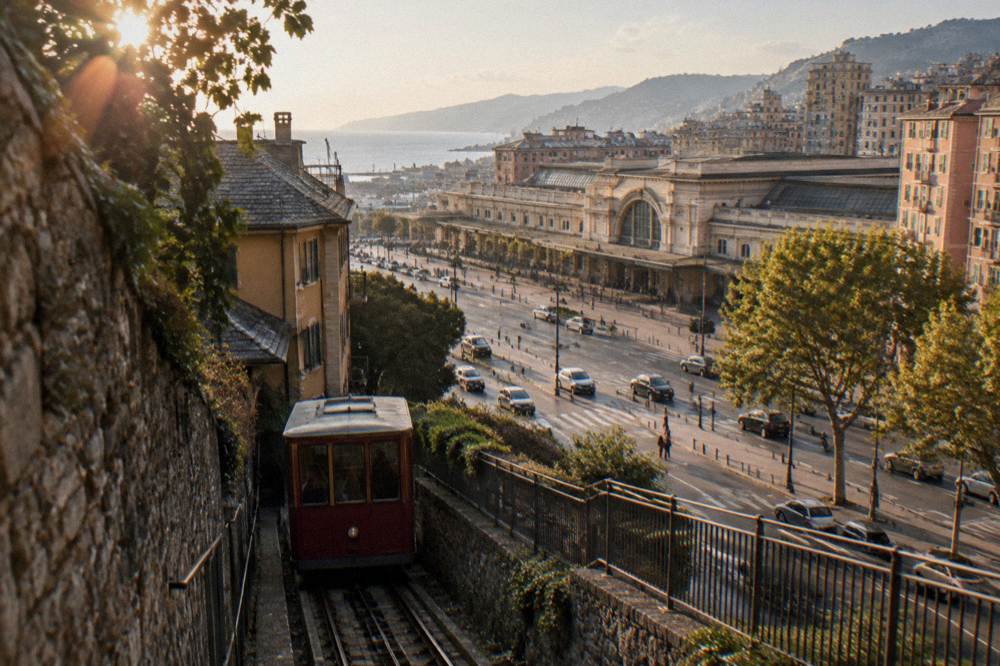
A car of any kind, taxi or otherwise, is honestly a poor fit for the parts of Genoa people come to see. The old town covers 113 hectares and is described on the official tourism site as one of the largest medieval historic centres in Europe, and its lanes were laid out for foot traffic, with a limited-traffic zone (ZTL) covering the Centro Storico and other areas under rules set by the comune. Parking is not the plan here. The plan is the lifts, the funicular and your shoes, which is the argument made in full in is Genoa a walkable city.
What Does Public Transport Cost In Genoa?
An AMT ordinary ticket costs 2.00 EUR and is valid 110 minutes on the whole Città Metropolitana network, with an integrated AMT plus Trenitalia version at 2.20 EUR, a 5-hour ticket at 5.00 EUR and a carnet of eleven 110-minute tickets at 20.00 EUR. The Met Daily 24-hour pass costs 10.00 EUR and covers buses, the metro, lifts, the funiculars and the Volabus airport service.
That fare table is the backbone of moving around Genoa without a ride-hailing app. A single 2.00 EUR ticket covers a bus ride, a metro leg and a connection, as long as the whole chain finishes inside 110 minutes. The integrated 2.20 EUR version adds limited Trenitalia urban segments, which matters if your hotel sits near a station such as Genoa Nervi rather than in the centre. The Met Daily is the one to reach for on arrival day, because it folds the airport bus and a full day of city movement into a single 10.00 EUR purchase.
| AMT ticket | Price | Validity |
|---|---|---|
| Ordinary single | 2.00 EUR | 110 minutes, whole network |
| AMT + Trenitalia integrated | 2.20 EUR | 110 minutes, urban plus limited rail |
| 5-hour ticket | 5.00 EUR | 5 hours from validation |
| Carnet of 11 tickets | 20.00 EUR | 11 x 110-minute journeys |
| Met Daily | 10.00 EUR | 24 hours, full network incl. Volabus |
| Lift or Sant'Anna funicular ride | 1.20 EUR | Single vertical ride |
The vertical network deserves its own line, because it is the most Genoa-specific transport there is. AMT runs public lifts across the city's hills, and a ride on the Castelletto Levante lift or the Sant'Anna funicular costs 1.20 EUR. The Castelletto Levante lift climbs 57 m from Piazza Portello to the Spianata Castelletto viewpoint and runs daily from 06:40 to 24:00, the same hours as the Zecca-Righi funicular. These are not tourist gimmicks; they are scheduled services with published fares, and they replace exactly the uphill slogs that might otherwise tempt someone toward a car.
Once the fare system clicks, the case for a guided start to the city becomes obvious: the centre rewards being on foot with someone who can read it. The intro walking tour through 3,000 years of Genoa does exactly that, and you can Check availability alongside the operator's live listing details.
Is The Metro Enough On Its Own?
The Genoa metro is a single 7 km line with eight stations, Brin to Brignole, serving Dinegro, Principe, Darsena, San Giorgio, Sant'Agostino and De Ferrari in between, and it uses the same 2.00 EUR AMT ticket as the buses. It is a useful spine through the western half of the centre, not a replacement for buses, lifts or taxis across the whole city.
Two extensions are in progress but not open: the branch to Canepari is reported as targeted for June 2027 and the one to Martinez for December 2028. Until then the eight-station line is what exists, and it pairs neatly with the funiculars and lifts for the vertical city above it. For anything east along the coast, such as Nervi, the train from Genova Brignole or Genova Piazza Principe is the tool, which is why the stations matter to anyone staying more than a night, as laid out in the guide to Genoa's train stations.
If your question is really about coverage, the honest framing is that the metro handles a slice, AMT buses handle the rest of the surface, and the trains handle the Riviera. The same ticket logic runs through all of it, and the metro's own slice is covered in is there a metro in Genoa.
What If You Want To Leave The City Without A Car?
Boats and trains replace the car for the big day trips: AMT line 782 runs from Santa Margherita Ligure to Portofino and is included in the Met Daily ticket, Golfo Paradiso's Two Gulfs tour departs Genoa Porto Antico and calls at Camogli, San Fruttuoso and Portofino, and the Tigullio boat network links Rapallo, Santa Margherita, Portofino and the Cinque Terre area on seasonal lines.
The Met Daily detail is the one people miss: a 10.00 EUR day pass that includes the airport bus also includes line 782 to Portofino, one of the priciest taxi corridors on the coast. Combine it with the Tigullio boats and a Portofino day costs train fare plus a day pass plus a boat ticket, with no car and no parking. Portofino itself sits inside a limited-traffic zone where non-residents use paid car-park silos at a reported 8 EUR per hour, which is the strongest argument ever written for arriving by water. The boat option is unpacked in can I take a boat ride from Genoa to Portofino.
For the Cinque Terre, the Treno Card is the relevant product, with adult one-day prices from 22.00 to 35.00 EUR depending on the date band, and the Via dell'Amore path included with a booked time slot. The question of whether a boat substitutes for a train on that route has its own answer page in is there a ferry from Genoa to the Cinque Terre. The pattern is consistent: on this coast, the water and the rail line are the transport, and wheels are what you leave behind.
Do You Even Need Rides, Or Is Genoa Better On Foot?
For the historic centre, the Strade Nuove, the Porto Antico and the Aquarium, walking beats any vehicle, and the AMT lifts and funiculars exist precisely to handle the hills in between at 1.20 EUR a ride. The caruggi are pedestrian in character, the UNESCO-listed Strade Nuove and the system of the Palazzi dei Rolli line compact streets, and the Zecca-Righi funicular climbs to a terrace viewpoint in about 12 minutes.
This is the real answer to the ride-hailing question for day-to-day sightseeing. Genoa's core sights sit close enough that a 110-minute ticket can cover two rides with museum time in between, and the vertical connections are priced like bus fares rather than scenic attractions. A sensible car-free day: walk the old town in the morning, take the Castelletto Levante lift up for the panorama, come down to Via XX Settembre, and finish at the Porto Antico. Add the ordinary safety habits of any port city, which are discussed in is Genoa a safe city for tourists, and the app question starts to feel beside the point.
Common Questions About Getting Around Genoa
Can I Use Uber In Genoa?
Plan around taxis and the AMT network instead. The airport's fixed taxi fare is 25 EUR per car into the centre, an AMT ticket is 2.00 EUR for 110 minutes, and the 10.00 EUR Met Daily covers the airport bus and the whole network for a day. For more context see whether Genoa is walkable.
How much is a taxi from Genoa airport to the city centre?
The airport's own page sets a fixed 25 EUR per car for up to four people, 30 EUR for over four, with a 2 EUR supplement at night and on holidays. Shared per-person rates of 8 EUR to Brignole and 7 EUR to Principe apply with a three-person minimum.
What is the cheapest way to get from Genoa airport to the centre?
The Volabus, which needs the 10.00 EUR Met Daily 24-hour ticket, and runs airport to Genova Piazza Principe, De Ferrari and Genova Brignole in about 30 minutes. The pass then covers buses, the metro, lifts and funiculars for the rest of the day.
How long does an AMT ticket last?
The ordinary ticket costs 2.00 EUR and is valid 110 minutes on the whole Città Metropolitana network. An integrated AMT plus Trenitalia version costs 2.20 EUR, a 5-hour ticket 5.00 EUR, and a carnet of eleven tickets 20.00 EUR.
Can I reach Portofino without a car?
Yes. Train to Santa Margherita Ligure, then AMT line 782 to Portofino, which is included in the Met Daily ticket, or the Tigullio seasonal boats with a Santa Margherita to Portofino return reported at about 20 EUR. Portofino's car access is limited to residents, with paid silos at a reported 8 EUR per hour for everyone else.
Is the Genoa metro useful for tourists?
Partly. It is a single 7 km line, Brin to Brignole, with eight stations including Principe, San Giorgio, Sant'Agostino, De Ferrari and Brignole, all on the standard 2.00 EUR AMT ticket. It covers a useful slice of the centre; buses, lifts and trains cover the rest.
The final word from Genoa Travel Guide: arrive, buy a Met Daily, and let the lifts do the climbing.